
Free AI to Spy on Competitor Social Media Ad Strategies: If you’re running social media ads, one of the smartest things you can do is study what your competitors are already putting in front of their audiences.
I’m not talking about stealing campaigns, accessing private advertising accounts, or trying to uncover confidential targeting information.
I’m talking about something much simpler: looking at publicly available competitor ads, organizing what you find, and using free AI tools to identify patterns.
This approach can save a huge amount of time.
Instead of creating every Facebook, Instagram, or TikTok ad from scratch and guessing what type of creative might work, you can study the messages, formats, offers, hooks, visuals, and calls to action competitors are publicly using.
Then AI can help turn that information into a structured competitive analysis.
For example, if I find that several successful brands in the same niche repeatedly use customer testimonials, before-and-after demonstrations, discount offers, and short UGC-style videos, that’s useful information.
It doesn’t prove that every one of those strategies will work for my business.
But it gives me hypotheses worth testing.
This guide explains how to use free AI tools and public advertising resources to research competitor social media ad strategies, analyze their creative patterns, and turn those observations into better campaigns.
What Does Competitor Ad Research Actually Mean?
Competitor ad research means studying publicly visible advertising from businesses competing for the same customers.
Depending on the platform, publicly available information may include:
- Ad creative
- Video
- Images
- Headlines
- Primary text
- Calls to action
- Landing pages
- Offers
- Products being promoted
- Creative formats
- Advertiser identity
- Some platform-specific performance or transparency information
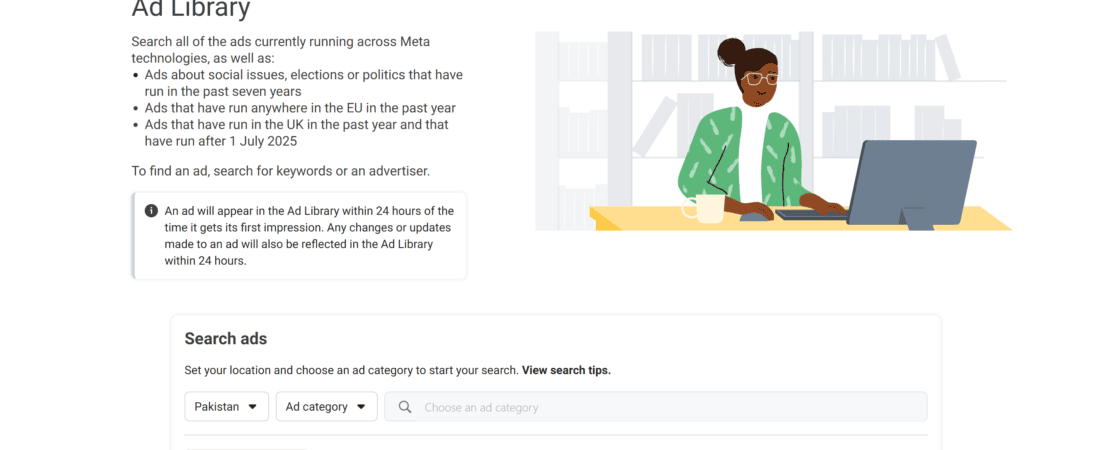
For example, Meta’s Ad Library lets users search ads currently running across Meta products. Meta also explains that you can see a Page’s current ads even if you’re not part of the intended audience.
That’s extremely useful for competitive research.
Instead of wondering what competitors are advertising, you can actually look at their public campaigns.
Why Use AI for Competitor Ad Research?
The difficult part isn’t necessarily finding ads.
The difficult part is making sense of dozens or hundreds of ads.
Imagine finding 80 competitor creatives.
You could manually inspect every one and take notes.
Or you could give the text, descriptions, screenshots, and observations to an AI assistant and ask it to organize them.
For example, AI can help categorize ads into:
- Discount-focused
- Problem-solution
- Testimonial
- Educational
- UGC
- Product demonstration
- Before-and-after
- Founder story
- Comparison
- Seasonal promotion
It can also identify recurring phrases and creative patterns.
This turns a pile of ads into a strategy document.
The Most Important Rule: Study Patterns, Not Secrets
There is a major difference between competitive intelligence and attempting to access information you aren’t authorized to see.
I focus on information that is publicly available.
I don’t recommend:
- Breaking into advertising accounts
- Obtaining private analytics
- Bypassing access controls
- Scraping restricted information
- Stealing creative assets
- Impersonating competitors
- Copying advertisements word-for-word
The goal is to understand the market.
If five competitors independently use short product-demo videos, that’s a pattern.
You can learn from the pattern without copying any individual advertisement.
1. Meta Ad Library — My First Stop for Facebook and Instagram Research
Meta Ad Library is one of the most useful free resources for competitor advertising research.
Meta describes the Ad Library as a searchable place for ads running across Meta products. For ordinary ads, it focuses on currently active ads; political and issue-related ads have additional historical transparency information.
My workflow with Meta Ad Library
I start by identifying three to five direct competitors.
Then I search for each brand.
I don’t immediately start copying headlines.
Instead, I ask:
What are they repeatedly advertising?
Suppose I’m researching skincare brands.
I might notice that one brand has:
- Five product demonstration videos
- Three customer testimonial creatives
- Two discount ads
- Several creator-style videos
That tells me something.
If the same product is being promoted through many different creatives, the brand may be testing multiple angles rather than relying on one advertisement.
Meta also allows users to view a Page’s active ads and select different countries when available.
That matters for international research.
A brand may advertise differently in Pakistan, the UK, the US, or another market.
What I like most
The biggest advantage is that I’m not relying solely on competitor screenshots posted elsewhere.
I can inspect the public advertising library directly.
Best for
- Facebook ads
- Instagram ads
- E-commerce research
- Offer analysis
- Creative research
- Competitor monitoring
2. TikTok Creative Center — My Go-To for Short-Form Ad Inspiration
TikTok Creative Center is especially useful when I’m researching video advertising.
TikTok’s Creative Center is publicly available and includes creative inspiration, trends, examples, and tools. Its Top Ads section contains high-performing creatives that can be filtered by region, industry, campaign objective, and other criteria.
My workflow with TikTok Creative Center
I start with the industry rather than immediately searching for a single competitor.
For example:
Beauty → skincare → target region
Then I look at the ads.
I’m paying attention to the first three seconds.
That’s important because short-form advertising has an extremely limited amount of time to earn attention.
I record:
- Opening visual
- First spoken sentence
- Text overlay
- Product appearance
- Video length
- Editing style
- CTA
- Offer
- Emotional angle
TikTok’s Top Ads dashboard can also provide performance-oriented information and second-by-second or frame-by-frame analysis for qualifying ads.
That makes the tool particularly interesting for creative research.
What I like most
It helps me move beyond simply asking, “What are competitors posting?”
Instead, I can ask:
“What creative patterns appear repeatedly among ads the platform highlights as high-performing?”
Best for
- TikTok ads
- UGC research
- Video hooks
- Short-form creative
- Creative trends
3. Google Ads Transparency Center — Useful for YouTube Competitor Research
Google Ads Transparency Center is another valuable public research resource.
Google describes it as a place where users can search for ads by advertiser name or website and find active ads published through Google. It also provides transparency around paid content on YouTube.
My workflow
If a competitor has a strong YouTube presence, I search for the advertiser.
Then I examine the visible campaigns and ask:
- What products are they pushing?
- Which claims appear repeatedly?
- What type of creative are they using?
- Is the message educational or promotional?
- Are they emphasizing price?
- Are they emphasizing a problem?
- Are they emphasizing a product benefit?
The key word here is repeatedly.
One advertisement might be an experiment.
A recurring message is more interesting.
What I like most
It expands competitor research beyond Meta and TikTok.
Best for
- YouTube advertising
- Search-ad transparency
- Brand research
- Cross-platform competitor analysis
4. ChatGPT — My Main Tool for Turning Ads Into a Strategy
After collecting competitor ads, I use an AI assistant to analyze them.
ChatGPT is particularly useful because I can give it structured information.
My workflow
Suppose I collect 20 ads from five competitors.
I create a spreadsheet with columns such as:
| Brand | Hook | Format | Offer | CTA | Main Benefit | Audience Angle |
|---|---|---|---|---|---|---|
| Brand A | Problem | UGC | 20% off | Shop Now | Convenience | Busy users |
| Brand B | Demo | Video | Free shipping | Buy Now | Results | Product-focused |
| Brand C | Testimonial | Video | None | Learn More | Trust | Beginners |
Then I ask AI to analyze the dataset.
For example:
“Analyze these competitor advertisements. Identify recurring hooks, offers, creative formats, customer problems, emotional angles, CTAs, and product benefits. Separate common patterns from unusual strategies. Do not assume that repeated use proves an ad is profitable.”
That final instruction matters.
We don’t know the competitors’ actual ROAS simply by looking at their ads.
What I like most
AI can turn scattered observations into organized categories very quickly.
Best for
- Competitive analysis
- Pattern recognition
- Ad copy analysis
- Strategy brainstorming
- Creative categorization
5. Google Gemini — Useful for Comparing Large Amounts of Ad Information
Gemini can also be useful when I have a large amount of text and research notes to analyze.
My workflow
I might give it:
- Competitor ad copy
- Product descriptions
- Offers
- Headlines
- My own campaign ideas
Then I ask:
“Compare these competitor advertising messages with my current positioning. Identify areas where my messaging is too similar, areas where the market appears saturated, and potential positioning opportunities.”
That’s more valuable than asking AI to simply summarize the ads.
I want it to help me identify gaps.
What I like most
I can use the analysis to move from competitor observation toward differentiation.
Best for
- Message comparison
- Positioning analysis
- Competitive research
- Finding gaps
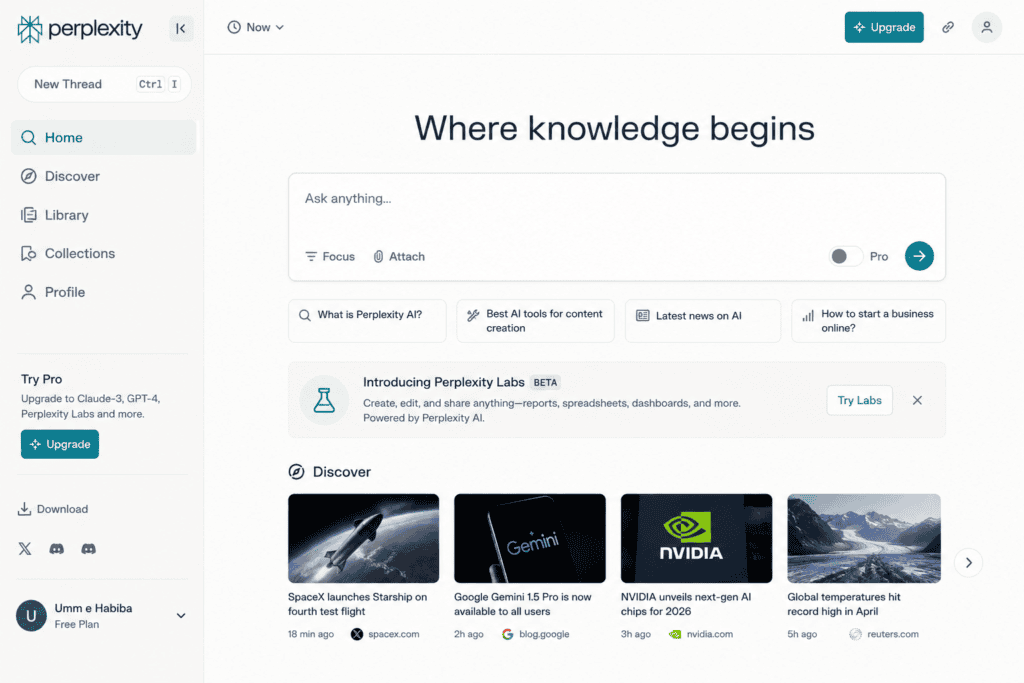
6. Perplexity — My Research Assistant for Competitor Context
Perplexity can be useful when I want to understand the broader context around a competitor.
My workflow
Instead of asking:
“What ads is Brand X running?”
I might ask:
“What products, offers, customer segments, and marketing positioning does Brand X publicly communicate across its website and social channels?”
Then I compare that information with the ads I found.
This helps answer an important question:
Does the advertising message match the broader brand positioning?
For example, a company might position itself as premium on its website but advertise heavily around discounts.
That’s a strategic observation.
What I like most
It can help connect advertising observations with broader publicly available brand information.
Best for
- Research summaries
- Competitor positioning
- Market research
- Source-based research
7. Canva — My Tool for Rebuilding the Strategy, Not Copying the Creative
Canva is useful after the research stage.
I don’t use it to recreate a competitor’s exact advertisement.
Instead, I use the strategic findings to create a completely different concept.
Suppose I discover that competitors in my niche frequently use:
Hook → Product Demo → Benefit → CTA
That’s a structure.
I can use the same general structure while creating original:
- Script
- Visuals
- Branding
- Product demonstration
- Copy
My workflow
I might create three original concepts:
Concept A
Problem → Solution → Product
Concept B
Customer story → Product → Result
Concept C
Comparison → Product benefit → CTA
Then I can visually prototype them.
What I like most
It helps turn research into actual creative concepts.
What Exactly Should You Analyze in Competitor Ads?
Finding advertisements is only the beginning.
I recommend analyzing at least eight elements.
1. Hook
What happens immediately?
Examples:
- Question
- Shocking statement
- Problem
- Demonstration
- Bold claim
- Visual transformation
2. Offer
Look for:
- Discount
- Free shipping
- Bundle
- Free trial
- Limited-time promotion
- Bonus
3. Creative format
Examples:
- UGC
- Product demo
- Carousel
- Static image
- Founder video
- Testimonial
- Animation
4. Message
What is the central promise?
5. Emotional trigger
Does the ad focus on:
- Fear
- Convenience
- Desire
- Status
- Savings
- Curiosity
- Trust
- Belonging
6. CTA
Examples:
- Shop Now
- Learn More
- Sign Up
- Get Started
- Buy Now
7. Landing page
Where does the advertisement send people?
8. Repetition
Is the brand repeatedly using the same angle?
This last point is extremely useful.
How AI Can Identify Competitor Ad Patterns
Let’s say I collect 50 advertisements.
I ask AI to classify them.
The output might look something like:
| Strategy | Number of Ads |
|---|---|
| Product Demonstration | 18 |
| UGC | 14 |
| Discount | 10 |
| Testimonial | 8 |
| Educational | 6 |
| Founder Story | 4 |
Now I have a basic picture of the market.
But I shouldn’t automatically conclude:
“Product demonstrations must be the best strategy.”
Maybe the industry simply prefers that format.
The correct conclusion is:
“Product demonstrations are common enough to deserve testing.”
That’s a much more disciplined approach.
Use AI to Analyze Competitor Hooks
One of my favorite prompts is:
“Analyze these competitor ad hooks. Group them into problem-based, curiosity-based, benefit-based, emotional, testimonial, demonstration, and offer-based hooks. Identify which patterns appear most frequently. Then suggest 20 original hooks for my brand that use the underlying psychological principle without copying competitor wording.”
This creates a useful separation between learning from a strategy and copying an advertisement.
Use AI to Analyze Competitor Offers
Offers can reveal a lot.
Suppose I notice competitors repeatedly using:
- 20% discounts
- Buy one get one
- Free delivery
- Bundles
- First-order discounts
That tells me price incentives may be common in the market.
Instead of automatically matching the discount, I could ask AI:
“These competitors frequently use discounts. Suggest five alternative value propositions that could make my product attractive without competing entirely on price.”
Possible directions might include:
- Better guarantee
- Faster delivery
- Premium packaging
- Exclusive bundle
- Personalized service
Now competitive research is helping me differentiate.
Use AI to Find Creative Gaps
This is where the process becomes more interesting.
Imagine that after analyzing 100 ads, I discover:
80% are product-focused.
15% are testimonial-focused.
5% are educational.
That doesn’t prove educational advertising will win.
But it gives me an opportunity to test something different.
I could create an educational campaign explaining:
- How the product works
- Common mistakes
- Buying considerations
- Product comparisons
- Expert tips
The goal isn’t to be different simply for the sake of being different.
The goal is to find an underserved creative angle.
Create a Competitor Ad Swipe File
I recommend maintaining a simple spreadsheet.
Useful columns include:
- Brand
- Platform
- Ad URL
- Date observed
- Creative type
- Hook
- Main message
- Offer
- CTA
- Product
- Audience
- Emotional angle
- Notes
- Potential lesson
You can then give this information to AI whenever you want a fresh analysis.
Over time, the spreadsheet becomes much more valuable than a random collection of screenshots.
How to Analyze Competitor Ads Weekly
You don’t need to spend hours every day.
A simple weekly routine can work.
Monday
Check five competitors.
Tuesday
Collect interesting ads.
Wednesday
Analyze hooks.
Thursday
Analyze offers.
Friday
Generate new creative ideas based on the findings.
This creates a continuous research loop.
Don’t Assume an Active Ad Is a Winning Ad
This is one of the biggest mistakes in competitor research.
An ad being visible does not tell you everything about its performance.
There can be many reasons an advertisement remains active.
It might be:
- Profitable
- Break-even
- Being tested
- Supporting another campaign
- Retargeting
- Running to a small audience
- Part of a broader strategy
So I treat ad longevity as a signal, not proof.
Similarly, a platform’s highlighted creative-performance information doesn’t mean you know the advertiser’s complete business economics.
Why Repeated Competitor Messaging Matters
One ad can be random.
Ten ads around the same promise are more interesting.
For example, if a skincare company repeatedly talks about:
“Visible results without complicated routines.”
that’s probably part of its positioning.
I would record that message and compare it with other competitors.
Maybe everyone is talking about:
Price
while nobody talks about:
Simplicity
That could become an opportunity.
Use AI to Build a Competitor Messaging Matrix
I find matrices extremely useful.
For example:
| Brand | Price | Quality | Convenience | Results | Trust | Speed |
|---|---|---|---|---|---|---|
| A | High | Strong | Medium | Strong | Strong | Medium |
| B | Low | Medium | Strong | Medium | Medium | Strong |
| C | Medium | Strong | Strong | Strong | Strong | Medium |
The exact ratings are subjective unless backed by measurable evidence.
That’s okay if you clearly label them as qualitative observations.
The purpose is to visualize positioning.
How to Research Competitor Landing Pages
Don’t stop at the advertisement.
Click the publicly visible destination when appropriate.
Then analyze:
- Headline
- Offer
- Product presentation
- Testimonials
- Pricing
- CTA
- Form
- Guarantees
- FAQ
- Page speed
- Mobile experience
Ask AI:
“Compare these five competitor landing pages based on clarity, offer strength, trust signals, friction, CTA placement, and messaging consistency. Identify opportunities for differentiation.”
Now you’re analyzing the entire customer journey.
Competitor Ad Research for E-Commerce
For e-commerce, I pay special attention to:
Product demonstrations
How is the product used?
Benefits
What problem does it solve?
Reviews
Are customer experiences featured?
Discounts
What type of incentives are common?
Bundles
Are multiple products packaged together?
UGC
Are creators demonstrating the product?
Before-and-after content
Is transformation the main selling point?
These patterns can help generate your own original concepts.
Competitor Ad Research for Service Businesses
For service businesses, the strategy is slightly different.
I look for:
- Case studies
- Client results
- Testimonials
- Founder authority
- Educational content
- Free consultations
- Lead magnets
- Guarantees
- Problem-focused messaging
For example, if I’m researching digital marketing agencies, I might discover that almost everyone says:
“Grow your business online.”
That’s incredibly generic.
AI can help me find more specific positioning.
For example:
“Identify opportunities to make this agency’s advertising message more specific without making unsupported performance claims.”
Competitor Ad Research for Personal Brands
For personal brands, I focus more on:
- Storytelling
- Expertise
- Opinions
- Educational hooks
- Personal experiences
- Authority signals
- Community building
AI can categorize the content and identify which themes repeatedly appear.
A Powerful Competitor Analysis Prompt
Here’s one of my favorite prompts:
“Act as a senior performance marketing strategist. Analyze the competitor ad data below. Identify recurring creative formats, hooks, offers, customer problems, benefits, emotional triggers, CTAs, and positioning themes. Separate common market patterns from potentially distinctive strategies. Do not assume that frequency equals profitability. Based only on the information provided, identify five opportunities for original advertising concepts that could differentiate my brand. Do not copy competitor wording, visual concepts, or proprietary creative assets.”
This gives AI clear boundaries.
Another Prompt for Finding Creative Gaps
“Review these competitor advertisements and identify messaging angles that appear overused, moderately used, and underused. Then suggest original campaign concepts for my brand based on customer needs that competitors appear to address poorly. Avoid copying any competitor’s specific language, branding, imagery, or creative execution.”
This is particularly useful when the market feels saturated.
Use AI to Turn Competitor Research Into Ad Scripts
Once I’ve identified useful strategic patterns, I can ask AI to create original scripts.
For example:
“Create five 20-second UGC-style ad scripts for my skincare product. Use a problem-solution structure common in the category, but create completely original hooks, wording, examples, and scenes. Avoid making medical or unsupported performance claims.”
Now the research informs the creative without becoming plagiarism.
Don’t Copy Competitor Creative Word-for-Word
This should be obvious, but it’s worth saying.
If a competitor has:
“Stop wasting money on expensive skincare.”
don’t simply change one word and use:
“Stop wasting money on costly skincare.”
That’s not meaningful originality.
Instead, learn the underlying idea:
The customer is worried about wasting money.
Then create a different execution:
“Three skincare mistakes that quietly drain your budget.”
Same general customer concern.
Different concept and wording.
Ethical Competitor Research Is Better Long-Term
Copying can produce a quick idea.
It doesn’t create a strong brand.
If you constantly imitate competitors, your advertising becomes dependent on what someone else is doing.
Instead, I prefer this process:
Observe → Analyze → Understand → Differentiate → Test
That creates a much stronger creative system.
My Complete Free AI Competitor Ad Research Workflow
Here’s the workflow I would use.
Step 1: Choose five competitors
Prioritize direct competitors.
Step 2: Search Meta Ad Library
Record active ads.
Step 3: Search TikTok Creative Center
Study relevant high-performing creative examples.
Step 4: Search Google Ads Transparency Center
Check Google and YouTube advertising where relevant.
Step 5: Save the information
Use a spreadsheet.
Step 6: Categorize the ads
Record hooks, formats, offers, and CTAs.
Step 7: Feed the observations into AI
Ask for patterns.
Step 8: Identify overused angles
Find what everyone is saying.
Step 9: Identify gaps
Look for underused customer problems or positioning opportunities.
Step 10: Generate original concepts
Create new ads based on strategic insights.
Step 11: Design the creatives
Use Canva or another creative tool.
Step 12: Test
Run your own campaigns.
Step 13: Measure
Use your actual campaign data.
Step 14: Improve
Feed your own results back into the creative process.
The Difference Between Competitor Research and Competitor Copying
This distinction is worth remembering.
Research says:
“They’re using customer testimonials frequently.”
Copying says:
“I’ll use their testimonial structure and wording.”
Research says:
“Most competitors emphasize discounts.”
Copying says:
“I’ll recreate their discount advertisement.”
Research says:
“Short UGC videos are common in this niche.”
Copying says:
“I’ll reproduce their exact video concept.”
The first approach builds knowledge.
The second creates imitation.
Common Mistakes When Using AI for Competitor Ad Research
Mistake 1: Assuming AI knows private performance data
It doesn’t.
Public information has limits.
Mistake 2: Treating every active ad as successful
An active ad isn’t necessarily profitable.
Mistake 3: Copying competitor wording
Use insights, not their creative.
Mistake 4: Looking at only one competitor
One brand can give you a distorted view of the market.
Mistake 5: Ignoring your own audience
Your competitors’ strategy may work for their customers but not yours.
Mistake 6: Focusing only on visuals
The offer and positioning matter too.
Mistake 7: Never testing your ideas
Research is not a substitute for actual campaign data.
How Often Should You Research Competitor Ads?
For most small businesses, once a week is enough to maintain a useful research habit.
For highly competitive e-commerce businesses, checking more frequently may make sense.
I would avoid spending so much time watching competitors that I stop creating my own campaigns.
A useful rule is:
20% research, 80% execution and testing.
The exact ratio can vary, but competitor research should support your marketing—not replace it.
Final Thoughts
You don’t need an expensive competitor intelligence platform to learn a lot about social media advertising.
There is already a surprising amount of public information available.
Meta’s Ad Library lets you inspect active ads across Meta products.
TikTok Creative Center provides a public collection of creative inspiration, trends, and Top Ads, including filters and performance-oriented creative analysis for qualifying ads.
Google’s Ads Transparency Center lets you search for advertisers and inspect active Google advertising, including paid content on YouTube.
The real power comes when you combine those resources with AI.
Instead of simply collecting advertisements, you can ask:
What hooks keep appearing?
Which offers are common?
What problems are competitors emphasizing?
Which creative formats dominate the category?
What messages seem overused?
What customer needs appear underrepresented?
That’s where competitor research becomes strategic.
My preferred approach is not to “spy” in the sense of trying to discover confidential information.
It’s to observe publicly, analyze intelligently, and create independently.
AI is particularly good at taking a large amount of messy information and turning it into categories, patterns, comparisons, and new ideas.
But there’s one thing I wouldn’t outsource to AI: judgment.
An advertisement that looks successful doesn’t automatically mean its strategy will work for your business.
A competitor’s offer may be profitable because of their brand reputation, customer lifetime value, pricing, audience, or backend funnel.
You don’t have those same conditions.
So use competitor research as inspiration and market intelligence—not as a shortcut around testing.
The strongest workflow is:
Find public ads → Record patterns → Analyze with AI → Identify gaps → Create original concepts → Test them → Measure your results → Improve.
That’s a much more sustainable way to use free AI for competitor social media ad research.
You’re not trying to become your competitor.
You’re trying to understand the market well enough to build something better.
Frequently Asked Questions
Can I legally research competitor ads?
Generally, researching advertisements that platforms make publicly available is different from accessing private accounts or restricted data. Use official public transparency tools and respect platform terms, intellectual property rights, and applicable laws.
Can AI tell me how much my competitor spends on ads?
Not reliably for ordinary commercial campaigns. Public ad libraries can provide transparency information, but you should not assume that AI can determine a competitor’s exact budget, ROAS, profit, or targeting.
What is the best free tool for Facebook competitor ad research?
Meta Ad Library is the most direct starting point because it allows users to search active advertisements across Meta products.
What is the best free tool for TikTok competitor research?
TikTok Creative Center is particularly useful for researching creative trends and Top Ads. Its dashboard supports filtering and performance-oriented analysis for qualifying ads.
Can I copy a competitor’s ad after analyzing it?
I wouldn’t recommend copying their wording, branding, imagery, scripts, or distinctive creative execution. Instead, identify the underlying customer problem or advertising principle and develop an original concept.
How many competitors should I analyze?
Five is a useful starting point. For a deeper market analysis, you can expand to 10 or more, but focus on meaningful patterns rather than collecting enormous amounts of data.
Can AI find my competitor’s winning ad?
AI can help analyze publicly available information and identify patterns, but it cannot reliably know an advertiser’s private profitability or complete campaign performance.
How often should I monitor competitor ads?
Weekly monitoring is a practical starting point for many businesses. Highly competitive industries may benefit from more frequent checks.
Check out here if you want to know about Free AI Tools for Generating Interactive Quiz Content for Audience Engagement