
Free AI Brand Name Generators: Choosing a name for a new e-commerce business sounds like one of the easiest parts of starting a brand.
It isn’t.
I’ve spent plenty of time trying to find names that sound modern, are easy to remember, fit the product, and don’t feel like they were generated by randomly combining two words.
The problem becomes even bigger when you’re starting an online store.
A good e-commerce brand name needs to work in several places at once. It should look good on a website header, sound natural when someone says it aloud, fit on product packaging, work as a social media username if possible, and ideally leave enough room for the business to expand later.
This is where free AI brand name generators can be surprisingly useful.
Instead of staring at a blank page and trying to invent hundreds of names manually, I can describe the business, target audience, products, personality, and preferred naming style to an AI tool.
Within minutes, I can have dozens of possibilities to evaluate.
But there is an important difference between generating names and choosing a brand name.
AI is good at the first one.
The second still requires human judgment.
In this guide, I’ll cover some of the best free AI tools I use for generating e-commerce brand names, how I approach each tool, what makes a name memorable, useful prompts, mistakes to avoid, and how I personally narrow hundreds of AI-generated suggestions down to a small shortlist.
Why Your E-Commerce Brand Name Matters
Your brand name is often one of the first things customers encounter.
They might see it:
- On Instagram
- In a Google search
- On packaging
- In an advertisement
- On a product label
- In an email
- On a website
- In a marketplace listing
A weak name can make a good product feel less professional.
A strong name can make even a new business feel established.
But I don’t believe that a brand name needs to describe the product literally.
Think about the difference between:
“Affordable Women’s Clothing Store”
and a distinctive brand name.
The second gives the business room to develop an identity.
That’s especially important for startups because the products may change.
If I launch a store selling handmade candles and call it something extremely specific to candles, I might have a problem if I later expand into home fragrance, decor, or gift products.
A flexible brand name gives me more room to grow.
What Makes a Good E-Commerce Brand Name?
When I’m evaluating names, I look at several factors.
Easy to pronounce
If people don’t know how to pronounce it, word-of-mouth becomes harder.
Easy to remember
The name shouldn’t disappear from someone’s memory immediately.
Easy to spell
A customer should have a reasonable chance of finding you after hearing the name.
Distinctive
It shouldn’t sound almost identical to ten existing brands.
Flexible
The name should ideally allow the business to expand.
Visually appealing
I should be able to imagine it on:
- Packaging
- Logo
- Website
- Social media
Available enough to use
This is critical.
A name can sound perfect but be unusable because someone else already owns a relevant trademark or brand.
Why I Use AI for Brand Name Brainstorming
The biggest benefit isn’t that AI knows the perfect brand name.
It doesn’t.
The benefit is that AI can generate many different naming directions quickly.
For example, I can ask:
“Generate 50 short, modern brand names for a minimalist home decor e-commerce store. Names should be easy to pronounce, preferably one or two words, and should not contain obvious words like ‘home,’ ‘decor,’ or ‘interior.’”
Then I can explore the results.
Maybe I discover a naming style I hadn’t considered.
I can then tell AI:
“I like names similar in feeling to options 7, 13, and 21. Generate 30 more names with the same characteristics, but make them more premium.”
This iterative process is where AI becomes useful.
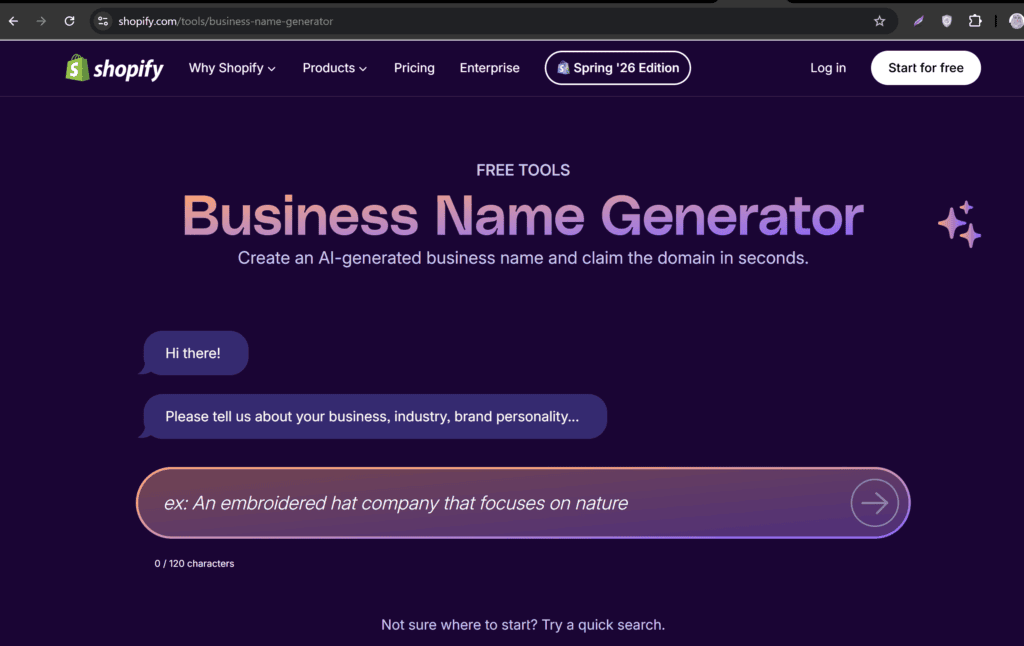
1. Shopify Business Name Generator — My Starting Point for E-Commerce
Shopify’s Business Name Generator is one of the first places I would check when I’m specifically naming an e-commerce business.
My experience using it
I like the fact that the tool is designed around businesses rather than just random word generation.
If I’m launching a store, I don’t necessarily want an abstract word that sounds like a software startup.
I want something that could actually appear above a product catalog.
I might enter a keyword related to the business and explore the generated options.
What I usually do is not immediately choose one.
Instead, I use the results to identify patterns.
Maybe I notice that I prefer:
- Short names
- Two-word names
- Invented words
- Soft-sounding names
- Premium names
Then I take that direction into an AI assistant and ask for more variations.
What I like most
It’s an easy starting point when the goal is specifically to name an online store.
Best for
- New e-commerce stores
- Shopify entrepreneurs
- Quick brainstorming
- Keyword-based name ideas
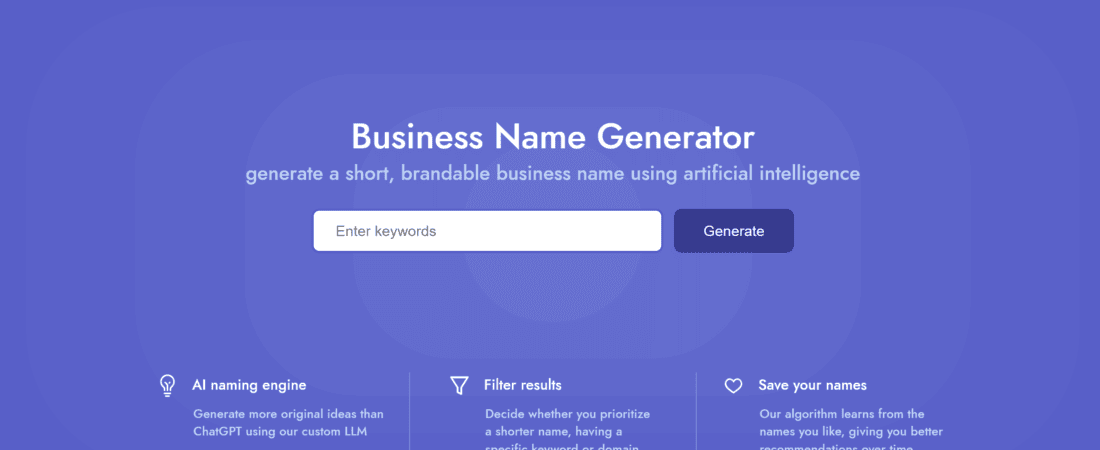
2. Namelix — My Favorite for Short, Brandable Names
Namelix is one of the tools I like when I’m looking for names that feel more like actual brands rather than descriptive business names.
My experience with Namelix
This is useful when I don’t want a name such as:
“Modern Home Accessories.”
I’d rather find something short and brandable.
I can enter keywords and experiment with different naming styles.
The results can range from descriptive names to more abstract brand concepts.
I particularly like this when I’m working on a business that wants to look modern.
For example, if I’m launching a minimalist jewelry store, I don’t necessarily want the word “jewelry” in the name.
I’d rather have a name that could become an identity.
I use the tool to generate possibilities, then manually filter them.
What I like most
The emphasis on short, brandable naming styles.
Best for
- Fashion brands
- Jewelry stores
- Beauty brands
- Lifestyle products
- Modern e-commerce businesses
3. Namecheap Business Name Generator — Useful When Domain Availability Matters
Namecheap is useful when I’m thinking about the relationship between a brand name and its domain.
My experience
A frustrating situation I’ve encountered during naming is finding an excellent name and then discovering that the domain situation is complicated.
That’s why I like checking domain availability early.
I don’t assume that a domain being available automatically means the brand is safe to use.
Those are completely different things.
But domain availability is still an important practical consideration for an e-commerce business.
If I have three equally good names and one has a clean, sensible domain available, that can influence my preference.
What I like most
The connection between naming and domain research.
Best for
- E-commerce websites
- Domain-conscious startups
- Online businesses
- Entrepreneurs building a website
4. Wix Business Name Generator — My Option for Simple Startup Brainstorming
Wix also provides business-name generation tools that can be useful during the early brainstorming stage.
My experience using Wix
I find this type of generator useful when I don’t yet know exactly what naming direction I want.
For example, suppose I’m starting an online store selling:
- Handmade gifts
- Stationery
- Accessories
- Lifestyle products
I might start with broad keywords and see what directions appear.
Then I can take the strongest concepts and ask an AI assistant to refine them.
This is important because I rarely expect a single generator to solve the entire naming problem.
I use several tools as idea sources.
What I like most
It’s easy to experiment without having to understand complicated naming systems.
Best for
- Beginners
- Small businesses
- General e-commerce brainstorming
- Early-stage ideas
5. Looka Business Name Generator — Useful for Thinking About the Brand as a Whole
Looka is interesting because it sits close to the broader branding process.
My experience
One thing I’ve noticed when naming brands is that I often judge a name differently after imagining the logo.
A name might look boring as plain text.
Then I imagine it as:
[Brand Name]
with a strong typeface and visual identity.
Suddenly it feels more interesting.
That’s why I like tools connected to broader branding workflows.
The name isn’t isolated.
It’s going to become:
- Logo
- Packaging
- Website header
- Social profile
- Product label
- Marketing material
What I like most
It encourages me to think about naming as part of the overall brand identity.
Best for
- New brand creation
- E-commerce startups
- Logo planning
- Visual identity exploration
6. ChatGPT — My Most Flexible Brand Naming Assistant
ChatGPT is probably the tool I use most when I need more control over the naming process.
The reason is simple.
I can explain exactly what I want.
My experience
Instead of:
“Give me brand names.”
I can say:
“I’m launching a premium women’s skincare e-commerce brand targeting women aged 25–40. The brand should feel clean, sophisticated, modern, trustworthy, and slightly luxurious. Generate 40 names that are short, easy to pronounce, and don’t directly contain words such as skin, beauty, glow, or care.”
That’s much more useful.
Then I can take the results further.
For example:
“Remove any names that sound like existing generic beauty brands.”
Then:
“Give me 20 names with a softer, more feminine sound.”
Then:
“Make the names shorter and easier to spell.”
This makes ChatGPT feel less like a name generator and more like a brainstorming partner.
What I like most
The ability to refine the naming criteria through conversation.
Best for
- Detailed naming briefs
- Creative naming
- Naming strategy
- E-commerce brands
- Shortlisting
7. Gemini — Useful for Exploring Naming Concepts
Gemini can also be useful when I want to explore different naming directions.
My experience
One thing I like doing is asking for names by concept, rather than only by product.
For example, instead of:
“Give me names for a candle company.”
I might say:
“Give me brand names inspired by warmth, evening light, calm spaces, and cozy rituals. The names should work for a premium home fragrance e-commerce brand.”
This produces a completely different naming direction.
I can also ask Gemini to explain the emotional impression of each name.
For example:
“For each name, describe whether it feels luxurious, playful, minimalist, natural, youthful, or traditional.”
That helps me understand how a name might be perceived.
What I like most
It can help connect names to broader concepts and emotions.
Best for
- Conceptual naming
- Brand personality
- Creative exploration
- Naming variations
8. Canva Magic Write — Useful for Combining Naming and Brand Direction
Canva can also become part of the naming process when I’m already designing the brand.
My experience
Sometimes I create a quick brand board and test different names visually.
I’ll put the candidate name into:
- Logo mockups
- Instagram profile designs
- Product packaging
- Business cards
This can reveal something that a text-based name generator cannot.
A name may sound excellent but look awkward in a logo.
Another name may feel ordinary in a list but look surprisingly premium when typeset.
That’s why visual testing is part of my naming process.
What I like most
I can test the name in an actual brand context.
Best for
- Visual naming tests
- Logo concepts
- Packaging
- Brand moodboards
Don’t Ask AI for “Unique Names” Without Restrictions
One of the weakest prompts I see is:
“Give me 100 unique brand names.”
The problem is that “unique” isn’t specific enough.
Instead, I define:
- Length
- Pronunciation
- Audience
- Industry
- Personality
- Naming style
- Words to avoid
- Words to include
- Geographic considerations
For example:
“Generate 30 short brand names for a minimalist home decor store. Names should be one or two words, easy for English and Urdu speakers to pronounce, modern but warm, and suitable for a premium audience. Avoid the words home, decor, house, living, interior, and luxury.”
Now the AI has constraints.
My Master Prompt for E-Commerce Brand Names
Here’s the prompt I use as a starting point:
“Act as a professional brand naming strategist. I’m launching an e-commerce business selling [products] to [target audience]. The brand should feel [3–5 personality traits]. Generate 50 brand name ideas that are easy to pronounce, easy to remember, visually attractive, and flexible enough for future product expansion. Avoid generic descriptive names and avoid these words: [words]. Divide the suggestions into descriptive, abstract, compound, invented, and premium-style names. For each name, briefly explain the idea behind it. Do not claim that any name or domain is available; I will verify availability separately.”
That last sentence is important.
I don’t want AI pretending that a name is legally available.
Generate Different Types of Brand Names
I don’t like limiting brainstorming to one naming style.
Descriptive names
These communicate what the company does.
Example:
FreshNest
Easy to understand but potentially less distinctive.
Compound names
Two concepts combined.
Example:
LunaLeaf
These can be memorable when done well.
Invented names
Completely new words.
These can feel highly brandable but require more marketing to establish meaning.
Abstract names
Names based more on sound and feeling.
Founder-based names
Using a person’s name.
This can work particularly well for personal brands.
Use AI to Create Short Names
Short names are often easier to remember.
I might tell AI:
“Generate 30 brand names between 4 and 8 letters. They should be easy to pronounce and spell.”
Then I remove anything awkward.
But short doesn’t automatically mean good.
A four-letter name that nobody can pronounce isn’t useful.
Check How the Name Sounds Out Loud
This is something I always recommend.
Say the name several times.
Then imagine saying:
“You can find us at ________.com.”
Does it sound natural?
Ask someone else to pronounce it after seeing it once.
If they pronounce it completely differently, that’s useful information.
Check the Spelling
Imagine someone hears your brand name in a conversation.
They search for it later.
Can they guess the spelling?
This matters for online businesses because discoverability often begins with a typed search.
If the spelling is intentionally unusual, the branding needs to compensate through strong marketing.
Don’t Pick a Name Just Because the Domain Is Available
This is a common mistake.
Suppose I find:
AmazingXYZStore.com
available.
That doesn’t mean I should build a brand around it.
The domain should support the brand, not determine it completely.
I first evaluate the brand name.
Then I investigate domain options.
Check Social Media Handles
For e-commerce businesses, social media matters.
I check whether reasonable usernames are available on platforms such as:
- TikTok
- YouTube
The exact username doesn’t have to be identical everywhere.
But having a consistent identity is useful.
Trademark Research Is Essential
This is probably the most important part of the process.
AI can generate a name.
A domain registrar can tell me whether a domain is available.
Neither one guarantees that I can legally use the name as a trademark.
Before committing money to:
- Packaging
- Website
- Inventory
- Advertising
- Logo design
I should conduct proper trademark research in the countries where I plan to operate.
If the business is serious, professional legal advice can be worthwhile.
Use AI to Evaluate Your Shortlist
Once I’ve narrowed the list to perhaps ten names, I use AI differently.
I might give it:
Name A
Name B
Name C
and ask:
“Compare these names for a premium skincare e-commerce brand. Evaluate memorability, pronunciation, perceived quality, flexibility for future expansion, emotional impression, and potential weaknesses. Do not determine legal availability.”
Now I’m using AI for analysis instead of generation.
That’s a much better use of it.
My 10-Point Brand Name Checklist
Before selecting a name, I ask:
1. Is it easy to say?
2. Is it easy to remember?
3. Is it easy to spell?
4. Does it fit the target audience?
5. Does it match the brand personality?
6. Does it look good visually?
7. Can the business expand beyond its first product?
8. Are reasonable domains available?
9. Are useful social handles available?
10. Has trademark availability been properly investigated?
If a name fails several of these tests, I don’t force it.
Example: Naming a Fashion E-Commerce Brand
Imagine I’m starting an online women’s clothing brand.
My brief might be:
Audience: Women aged 20–35
Positioning: Affordable premium
Style: Modern, feminine, minimal
Products: Dresses, co-ords, accessories
Future: Potential international expansion
I’d ask AI:
“Generate 50 short fashion brand names that feel modern, feminine, elegant, and international. Avoid directly using words such as fashion, style, clothing, dress, boutique, and wear.”
Then I’d select 10.
Then I’d test those names visually.
Then I’d research availability.
This is much more efficient than trying to invent names randomly.
Example: Naming a Skincare Store
For skincare, I’d use a different brief.
Audience: Women 25–40
Positioning: Clean and premium
Personality: Calm, trustworthy, sophisticated
Prompt:
“Generate 40 brand names for a premium skincare e-commerce company. The name should feel clean, modern, trustworthy, and sophisticated. Avoid generic terms such as beauty, skin, glow, care, pure, and cosmetics. Prefer short names that could work internationally.”
This creates a different naming universe.
Example: Naming a Home Decor Store
For home decor:
“Generate 40 brand names for a modern home decor e-commerce brand. The identity should feel warm, minimal, artistic, sophisticated, and approachable. Avoid words such as home, house, decor, interior, living, and luxury. Names should be easy to pronounce and suitable for future expansion into furniture and lifestyle products.”
Again, the constraints shape the result.
Use AI to Find Naming Themes
Sometimes I don’t want actual names immediately.
I want concepts.
For example:
“Give me 20 naming themes for a premium candle brand.”
The AI might suggest themes based around:
- Moonlight
- Ritual
- Warmth
- Botanical elements
- Evening
- Calm
- Architecture
- Luxury
Then I choose one theme.
After that:
“Generate 30 names inspired by the moonlight and evening ritual concept.”
This two-step approach often gives me better names than asking for everything at once.
Don’t Let AI Generate Hundreds of Names Without Filtering
More isn’t always better.
If I ask AI for 500 names, I’ll probably get:
- Repetitive names
- Awkward combinations
- Similar words
- Names that don’t fit
- Names that are difficult to pronounce
I prefer generating 30–50 at a time.
Then I filter.
Quality of selection matters more than quantity of generation.
Test the Name With Real People
Before committing, I like getting outside opinions.
Show the shortlist to several people and ask:
Which name do you remember?
Which sounds most premium?
Which one sounds trustworthy?
Which one would you click on?
Don’t explain the names too much beforehand.
I want to see their natural reaction.
Common AI Brand Naming Mistakes
1. Choosing the first name that sounds good
The first result isn’t necessarily the best.
2. Trusting AI’s “unique” claim
Always verify.
3. Ignoring trademarks
A free domain doesn’t equal legal availability.
4. Making the name too descriptive
You may limit future expansion.
5. Making it too complicated
Difficult pronunciation can hurt recall.
6. Using random spelling
Unusual spelling can make searches harder.
7. Ignoring the visual identity
Test the name as a logo.
8. Choosing a trend instead of a brand
Today’s naming trend may feel outdated later.
My Complete AI Brand Naming Workflow
Here’s the process I’d use for a new e-commerce startup.
Step 1: Define the business
Write down the products and future plans.
Step 2: Define the audience
Who is buying?
Step 3: Define the personality
Choose 3–5 brand characteristics.
Step 4: Research competitors
Understand existing naming patterns.
Step 5: Generate naming themes
Use AI.
Step 6: Generate names
Use several tools.
Step 7: Remove weak names
Delete difficult, generic, or overly similar options.
Step 8: Create a shortlist
Keep around 5–10.
Step 9: Test them visually
Create logo and packaging mockups.
Step 10: Check domains
Look for sensible domain options.
Step 11: Check social handles
Look across major platforms.
Step 12: Conduct trademark research
Do this before committing.
Step 13: Get human feedback
Ask people outside the project.
Step 14: Choose the name
Then build the identity.
Which Free AI Brand Name Generator Is Best?
There isn’t one universal winner.
My choice depends on the stage I’m at.
| Tool | What I Use It For |
|---|---|
| Shopify Name Generator | E-commerce brainstorming |
| Namelix | Short brandable names |
| Namecheap | Name + domain research |
| Wix Generator | Simple business ideas |
| Looka | Brand-focused naming |
| ChatGPT | Detailed naming strategy |
| Gemini | Conceptual naming |
| Canva | Visual name testing |
If I’m just beginning, I might use Shopify or Namelix.
If I need more creative control, I move to ChatGPT or Gemini.
Once I have a shortlist, I use domain and social research tools.
Finally, I test the names visually.
Frequently Asked Questions
What is the best free AI brand name generator?
There isn’t one perfect tool. Namelix is useful for brandable names, Shopify is useful for e-commerce brainstorming, while ChatGPT and Gemini provide more control over naming criteria.
Can AI create a unique business name?
AI can generate original combinations, but you should never assume a generated name is legally unique or available. Always perform domain, social media, and trademark checks.
Can AI check trademark availability?
AI can help you organize research and identify questions to investigate, but it shouldn’t be treated as a definitive trademark search or legal opinion.
Should my e-commerce brand name describe my product?
Not necessarily. A descriptive name can communicate the product quickly, but an abstract or brandable name may give you more flexibility as the business grows.
How long should an e-commerce brand name be?
There is no strict rule, but I generally prefer names that are reasonably short, easy to pronounce, and easy to spell.
Can I use an AI-generated brand name commercially?
You can use AI as a brainstorming tool, but before commercial use you should independently verify trademark conflicts, domain availability, social handles, and applicable legal requirements.
Should I include keywords in my brand name for SEO?
Not necessarily. Search engine optimization shouldn’t be the only consideration when naming a brand. Memorability, differentiation, user perception, and long-term brandability are often more important.
Final Thoughts
Finding a brand name for an e-commerce startup used to mean writing words on a piece of paper and hoping something clicked.
AI has made the brainstorming stage much faster.
I can start with a simple business idea and generate dozens of naming directions within minutes.
I can explore short names.
I can explore premium names.
I can explore playful names.
I can explore invented words.
I can create names inspired by nature, architecture, fashion, technology, culture, or almost any concept.
But I don’t treat AI-generated names as finished answers.
I treat them as raw material.
That’s an important distinction.
The strongest name might not be sitting at the top of the generated list.
It might appear after I’ve rejected 30 names and noticed a pattern.
It might come from combining two concepts.
It might come from a word AI suggested that I hadn’t considered.
It might even come from realizing that the best direction isn’t descriptive at all.
For me, the most effective process is:
Define the brand → Generate concepts → Generate names → Filter → Test visually → Check availability → Research trademarks → Get feedback → Decide.
Tools such as Shopify, Namelix, Namecheap, Wix, and Looka are useful for quick exploration.
ChatGPT and Gemini become more powerful when I give them detailed naming briefs.
Canva becomes useful when I want to see how a name actually looks as a brand.
And that’s ultimately the goal.
I’m not just naming a website.
I’m naming something that might eventually appear on packaging, advertisements, social media, products, invoices, emails, and perhaps even physical stores.
So I don’t ask only:
“Does this sound cool?”
I ask:
“Can people remember it?”
“Can they pronounce it?”
“Does it fit the customer?”
“Will it still make sense if the business expands?”
“Can I build a strong visual identity around it?”
“Can I legally use it?”
If the answer to those questions is yes, then I may have something worth building.
AI can help me get there faster.
But the final brand decision should still belong to the person building the business.
Check out here if you want to know about How to Use Free AI to Spy on Competitor Social Media Ad Strategies