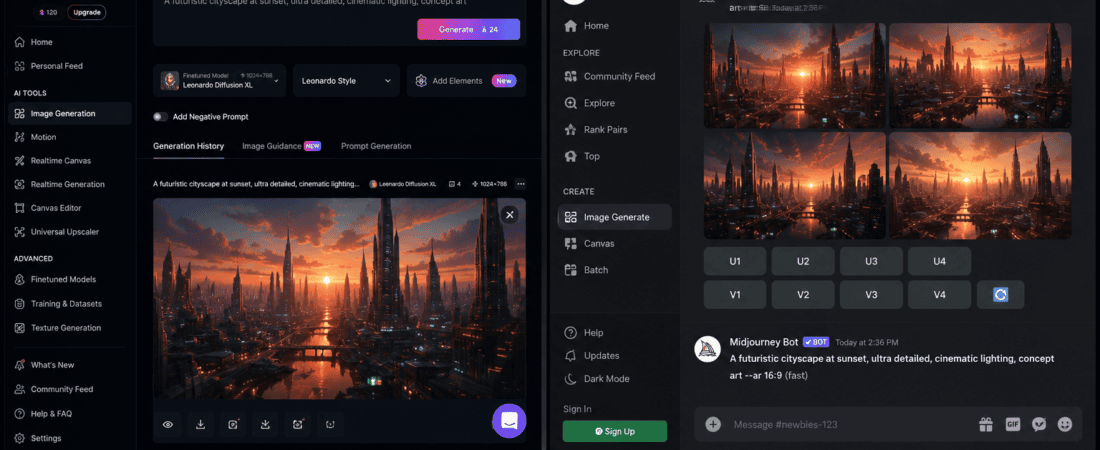
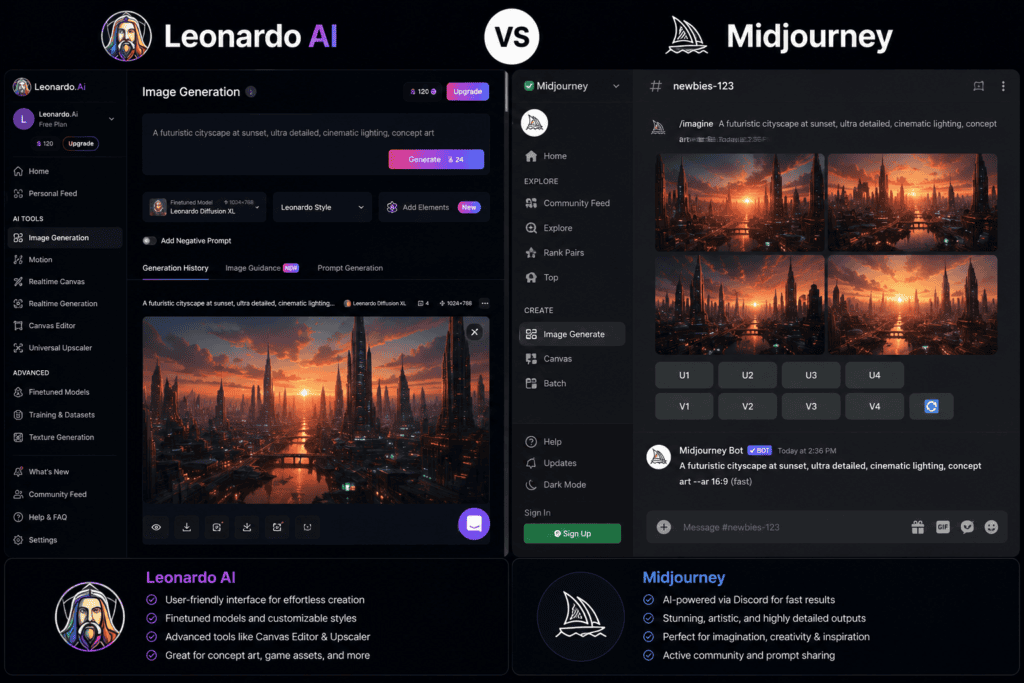
Leonardo AI vs Midjourney: AI image generators have changed the way people create visual content.
A few years ago, creating a professional-looking illustration, product concept, fantasy scene, character design, or marketing visual required expensive software and considerable design skills.
Today, you can describe an idea in a few sentences and generate an image within minutes.
Among the many AI image generators available, Leonardo AI and Midjourney remain two of the most interesting options for creators.
But there is an important difference between them.
Leonardo AI currently offers a genuine free tier, while Midjourney’s current website and Discord service do not offer a free trial. Midjourney does have a limited trial through the Niji Journey mobile app.
So if you’re searching specifically for the best free AI image generator, Leonardo AI has an obvious advantage.
However, the comparison becomes much more interesting when we look beyond price.
Midjourney has built a strong reputation for visually impressive artistic output and a streamlined image-generation experience. Leonardo AI focuses more heavily on creative control, multiple models, editing, image guidance, customization, and a broader production workflow.
That leads to the real question:
Leonardo AI vs Midjourney: which one should you actually use?
In this guide, I’ll compare the two based on image quality, free access, AI models, prompting, creative control, photorealism, character design, product photography, social media graphics, editing, consistency, commercial use, ease of use, and overall value.
I’ll also explain how I would approach common image-generation tasks with each tool so you can decide which one fits your workflow.
Leonardo AI vs Midjourney: Quick Comparison
| Feature | Leonardo AI | Midjourney |
|---|---|---|
| Free tier | Yes | No regular website/Discord free trial |
| Limited mobile trial | Not applicable | Niji Journey trial |
| Beginner friendliness | Excellent | Excellent |
| Image quality | Excellent | Excellent |
| Creative control | Excellent | Excellent |
| Multiple models | Yes | Primarily Midjourney models |
| Image editing | Strong | Strong |
| Character creation | Strong | Strong |
| Photorealism | Excellent | Excellent |
| Artistic images | Excellent | Excellent |
| Product concepts | Excellent | Excellent |
| Social media graphics | Excellent | Excellent |
| Custom models | Available on paid plans | Personalization/style tools |
| Commercial use | Subject to plan/terms | Yes, subject to terms |
| Best for free users | Leonardo AI | — |
| Best for artistic exploration | Leonardo AI | Midjourney |
| Best overall for beginners | Leonardo AI | Midjourney for paid users |
This table gives us the basic picture.
But image generation isn’t only about quality.
A tool can produce beautiful images while still being frustrating for a beginner.
That’s why the workflow matters.
What Is Leonardo AI?
Leonardo AI is an AI-powered creative platform for generating and editing images and other visual content.
It supports text-to-image generation as well as image-to-image workflows and offers a range of models and creative controls. Leonardo describes its platform as providing tools for creators who want speed, quality, consistency, and flexibility.
One of its biggest strengths is variety.
Instead of relying on one visual style, Leonardo provides access to multiple models and creative workflows.
Depending on the current platform configuration, users can work with Leonardo’s own models as well as other available models.
This makes it useful for:
- AI art
- Concept art
- Character design
- Product visuals
- Marketing graphics
- Game assets
- Illustrations
- Photorealistic imagery
- Creative experiments
For someone who likes experimenting with different visual directions, this flexibility can be valuable.
What Is Midjourney?
Midjourney is an AI image and video generation platform known for producing highly stylized and visually polished results.
It originally became famous through Discord-based image generation, although the service now also provides a web-based creation experience.
The basic concept is simple:
Describe what you want → Generate images → Refine → Upscale or modify
Midjourney’s official getting-started guide describes the process as entering a prompt into the Imagine bar and generating a set of images from that prompt.
One of Midjourney’s biggest strengths is its ability to turn relatively simple prompts into visually sophisticated images.
That makes it attractive to artists, designers, concept artists, marketers, and creators who care strongly about aesthetics.
Leonardo AI vs Midjourney: Which Is Actually Free?
This is the first major difference.
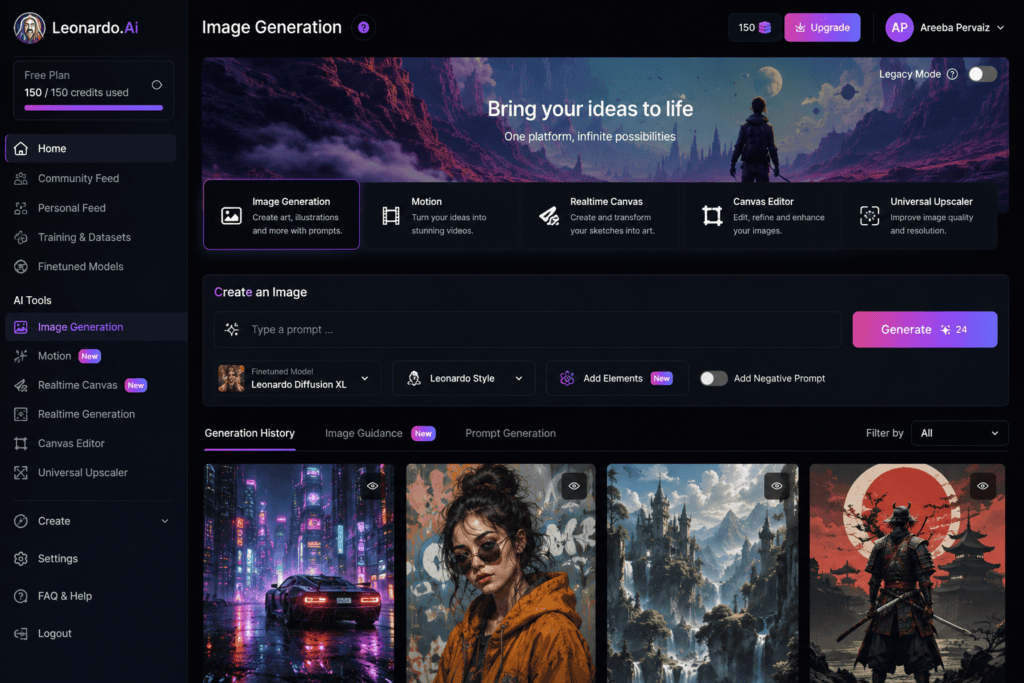
Leonardo AI
Leonardo currently offers a Free plan at $0/month with 150 fast tokens per day. Free users also receive access to certain models and limited creative features, although generation and other capabilities are restricted compared with paid plans.
This makes Leonardo a legitimate option if you want to experiment with AI image generation without immediately paying.
The free tier is particularly useful for:
- Learning prompting
- Testing styles
- Creating blog visuals
- Experimenting with concepts
- Generating social media ideas
- Understanding AI image workflows
Midjourney
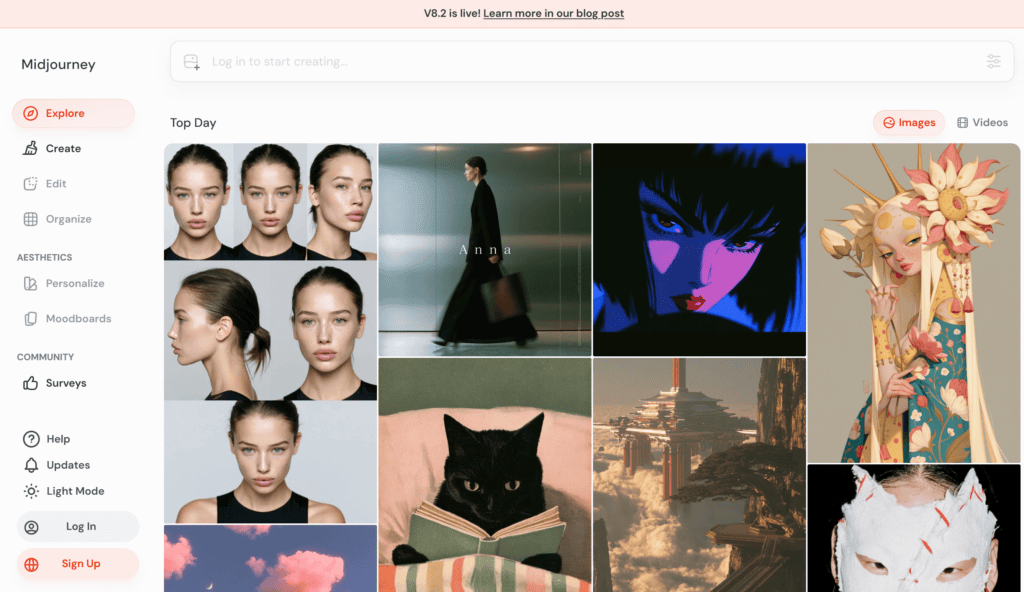
Midjourney currently does not provide a regular free trial on its website or Discord.
Its official documentation says a limited trial is available through the Niji Journey app on iOS and Android, but there is no current free trial on Midjourney’s website or Discord.
Current Midjourney subscriptions start at:
- Basic: $10/month
- Standard: $30/month
- Pro: $60/month
- Mega: $120/month
Annual billing is discounted compared with monthly billing.
Winner for free users: Leonardo AI
This category is straightforward.
If your budget is zero, Leonardo is the more practical option.
Leonardo AI vs Midjourney: Image Quality
Image quality is where things become much harder to judge.
Both platforms can produce impressive results.
But “better quality” isn’t a single measurable characteristic.
An image can be:
- More realistic
- More artistic
- More detailed
- More cinematic
- More consistent
- Better composed
- Better suited to a specific task
Midjourney has traditionally been particularly strong at aesthetic composition.
A relatively simple prompt can produce an image that already feels professionally art-directed.
Leonardo, meanwhile, gives you more room to experiment with models and settings.
My practical approach
If I’m trying to create a beautiful hero image quickly, I’d test Midjourney.
If I’m trying to explore multiple models, references, editing options, and controlled variations, I’d test Leonardo.
Winner: Tie
The winner depends heavily on the image you’re trying to create.
Leonardo AI vs Midjourney for Beginners
Both are accessible, but they teach image generation differently.
Leonardo gives beginners access to more controls.
That can be helpful, but it also means there are more settings to understand.
Midjourney keeps the basic creation process relatively straightforward.
The official Midjourney prompting guide actually recommends starting with short, simple prompts and adding important details when necessary.
That is useful advice for beginners.
You don’t need to write a huge paragraph every time.
Winner for simplest starting experience: Midjourney
Winner for beginner experimentation: Leonardo AI
Leonardo AI vs Midjourney for Prompting
Prompting is an important part of AI image generation.
But more words don’t automatically mean better images.
Midjourney’s own documentation recommends clear, focused prompts and explains that short prompts can work well because the model fills in some creative details itself.
For example:
cinematic portrait of a young woman in a rainy Tokyo street, neon reflections, shallow depth of field
That’s already enough to establish:
- Subject
- Environment
- Mood
- Lighting
- Composition
With Leonardo, I can also use more detailed prompts and combine prompting with model selection and image guidance.
Winner: Tie
Midjourney is excellent for simple creative prompting.
Leonardo is excellent when prompting is combined with additional controls.
Leonardo AI vs Midjourney for Photorealistic Images
Photorealism is one of the most popular AI image-generation use cases.
Creators use AI to generate:
- People
- Landscapes
- Interiors
- Product scenes
- Fashion imagery
- Food photography
- Lifestyle scenes
Leonardo provides models designed for different visual objectives, including photorealistic generation.
Its current platform includes models such as Lucid Origin, which Leonardo describes as an all-rounder for photorealistic and artistic styles.
Midjourney is also highly capable at photorealistic-looking imagery.
Which would I choose?
For a quick, polished lifestyle image, I’d test both with exactly the same prompt.
The results can vary significantly depending on the subject.
Winner: Tie
Leonardo AI vs Midjourney for Character Design
Character consistency is one of the biggest challenges in AI art.
Imagine you’re creating a children’s book.
You need the same:
- Face
- Hair
- Clothing
- Body proportions
- Color palette
- Character identity
across 20 illustrations.
Leonardo provides reference-based workflows and model customization options that can help creators work toward consistent characters.
Paid Leonardo plans also include personal AI model training limits, with higher tiers offering more training capacity.
Midjourney also provides personalization and reference-based features for controlling style and visual direction.
Winner: Leonardo AI for control
Winner for quick artistic character concepts: Midjourney
Leonardo AI vs Midjourney for Product Photography
This is particularly useful for e-commerce.
Suppose I have a basic product photo and want to place the product into:
- Luxury studio
- Marble countertop
- Modern bedroom
- Outdoor scene
- Fashion setting
- Restaurant table
Leonardo’s image guidance and editing capabilities can be useful for this kind of workflow.
I can start with a reference image and build a new environment around it.
Midjourney can also create excellent product concepts, especially when the goal is a visually striking advertising image.
Winner for controlled workflows: Leonardo AI
Winner for artistic advertising concepts: Midjourney
Leonardo AI vs Midjourney for AI Art
If your goal is simply:
“I want beautiful AI art.”
Midjourney deserves serious consideration.
It has a strong aesthetic identity.
A prompt like:
ancient fantasy city floating above the clouds, enormous waterfalls, golden sunset, cinematic atmosphere
can produce visually dramatic results.
Leonardo can also create impressive fantasy art, but its larger selection of models makes the experience more experimental.
Winner for distinctive artistic aesthetics: Midjourney
Leonardo AI vs Midjourney for Social Media Content
Social media creators often need lots of visuals.
For example:
- Instagram posts
- Pinterest pins
- Facebook ads
- Blog featured images
- YouTube thumbnails
- Quote graphics
- Product advertisements
Leonardo’s free tier makes it particularly attractive for creators who need to experiment without paying immediately.
I would use Leonardo to create a visual concept and then move the image into Canva or another design application for typography and layout.
Midjourney can produce excellent hero imagery, but the subscription cost makes it less attractive if you’re simply testing AI visuals.
Winner for budget-conscious creators: Leonardo AI
Leonardo AI vs Midjourney for Blog Featured Images
For bloggers, AI image generation can be extremely useful.
Instead of using the same generic stock photograph everyone else uses, you can create a custom image around the article.
For example, for an article about:
AI productivity tools
I might generate:
modern desk with laptop showing abstract AI interface, coffee cup, notebook, warm natural light, clean technology editorial photography, wide composition
Then I could crop it into:
- Blog header
- Pinterest pin
- Social post
- Newsletter image
Leonardo’s free tier makes this workflow especially accessible.
Winner: Leonardo AI
Leonardo AI vs Midjourney for Editing
Generation is only half the job.
Sometimes the image is almost perfect but one thing is wrong.
Maybe:
- The background needs changing.
- An object needs removing.
- The composition needs extending.
- The character needs modification.
- More space is needed around the subject.
Leonardo provides editing-oriented capabilities including inpainting and outpainting. Leonardo specifically highlights these tools as part of its creative-control workflow.
Midjourney also has tools for modifying creations, including variations, zooming, panning, and an Editor.
Winner: Leonardo AI for granular control
Leonardo AI vs Midjourney for Image Consistency
Consistency matters when you’re building:
- A brand
- A comic
- A game
- A product collection
- A children’s book
- A social media campaign
Leonardo’s ability to work with multiple models, references, and custom AI models can make it attractive for consistency-focused projects.
Midjourney has personalization, style references, image prompts, and other tools for maintaining a visual direction.
Winner: Leonardo AI
Leonardo AI vs Midjourney for Creative Control
This is one of the strongest arguments for Leonardo.
Its platform includes:
- Multiple models
- Image guidance
- Editing
- Inpainting
- Outpainting
- Presets
- Personal AI models
- Collections
- Quality settings
The current free plan has more restricted access to some of these capabilities, but the platform itself is designed around greater control.
Midjourney prioritizes a more streamlined creative experience.
That’s not necessarily a weakness.
Some people don’t want 30 settings.
They want to write a prompt and get something beautiful.
Winner: Leonardo AI for control
Winner: Midjourney for simplicity
Leonardo AI vs Midjourney for Artists
Artists may prefer different tools depending on their process.
If I want:
inspiration → variations → beautiful compositions
I’d consider Midjourney.
If I want:
generation → references → editing → refinement → customization
I’d lean toward Leonardo.
Winner: Depends on creative workflow
Leonardo AI vs Midjourney for Designers
Designers often need control.
For example, if I’m creating a campaign, I may need:
- Specific composition
- Specific product
- Specific colors
- Specific character
- Specific visual style
Leonardo’s control-oriented workflow can be valuable.
However, I wouldn’t expect either AI generator to produce a final advertisement perfectly every time.
The best workflow is usually:
AI image → design software → typography → branding → final export
AI generates the visual asset.
The designer turns it into a finished communication piece.
Which Has Better Style Control?
Midjourney has powerful style-oriented workflows.
Its documentation includes style references, image prompts, and personalization features for influencing the visual direction of generations.
Leonardo provides style and model selection through a broader collection of models and presets.
Winner: Tie
Midjourney is excellent for stylistic exploration.
Leonardo is excellent for combining style with additional control.
Leonardo AI vs Midjourney for Aspect Ratios
Aspect ratio matters when you’re creating content for different platforms.
You may need:
Instagram: 1:1 or 4:5
Pinterest: 2:3
YouTube: 16:9
Story/Reels: 9:16
Midjourney supports aspect-ratio parameters, and its documentation also describes using parameters with prompts.
Leonardo also provides image-generation controls that allow creators to adapt output to different formats.
Winner: Tie
Both can handle common social-media formats.
Leonardo AI vs Midjourney for Multiple Variations
Sometimes one image isn’t enough.
You want:
- Different colors
- Different compositions
- Different backgrounds
- Different characters
- Different camera angles
Midjourney has features such as permutations that let users generate multiple prompt variations from one prompt, with the number of variations depending on the subscription plan.
Leonardo also makes iterative experimentation easy through its generation and editing workflow.
Winner: Tie
Commercial Use: What Should You Know?
This is one area where you should never rely on assumptions.
AI image licensing can depend on:
- Your subscription
- The platform’s terms
- The type of content
- The model
- The source material
- Your country’s laws
Leonardo’s current terms say free-tier users receive a non-exclusive, royalty-free license for commercial use, while Leonardo retains certain rights over free-tier creations and public creations can be accessible to others. Paid users retain ownership rights under the platform’s terms.
Midjourney says users own images and videos they create, subject to its terms, including an exception requiring Pro or Mega for companies with more than $1 million in annual gross revenue.
This doesn’t mean you can safely generate anything you want.
For example, creating recognizable copyrighted characters, logos, or someone’s likeness can create separate legal issues.
Always check the current terms before using AI-generated images commercially.
Leonardo AI vs Midjourney for Privacy
Privacy can matter for client projects.
Midjourney’s current documentation states that creations are generally open by default, while Stealth Mode is available only on Pro and Mega plans.
Leonardo’s current pricing information states that free-tier creations are public, while paid plans offer private generations.
Therefore, if I’m creating confidential client concepts, I wouldn’t automatically assume that a free plan provides privacy.
I would check the current plan and privacy terms first.
How I Would Use Leonardo AI as a Beginner
If I were starting with Leonardo, I wouldn’t immediately experiment with every setting.
I’d use a simple workflow.
Step 1: Choose a clear subject
For example:
Luxury skincare bottle
Step 2: Define the environment
Minimal marble bathroom
Step 3: Define lighting
Soft morning sunlight
Step 4: Define style
Premium commercial photography
Step 5: Define composition
Centered product with negative space
The resulting prompt could be:
Premium skincare bottle on a white marble bathroom counter, soft morning sunlight, elegant luxury commercial photography, neutral beige palette, realistic reflections, clean composition, generous negative space around the product.
Then I’d generate several versions.
Instead of endlessly rewriting the prompt, I’d identify what is wrong.
If the product is too small:
Change composition.
If the background is too busy:
Simplify environment.
If the lighting is too harsh:
Change lighting.
This is much more effective than randomly adding adjectives.
How I Would Use Midjourney as a Beginner
I’d start even simpler.
Midjourney’s official documentation recommends concise prompts and emphasizes describing the things that matter to the image.
For example:
Luxury skincare product on marble surface, soft natural light, premium editorial photography, neutral tones
Then I’d study the generated options.
If the result is close, I’d refine the prompt.
If I want more cinematic imagery, I might introduce:
- Lighting
- Camera perspective
- Environment
- Mood
- Composition
The goal is to guide the model without overloading the prompt with unnecessary instructions.
Which Is Better for AI Portraits?
Both can produce excellent portraits.
Leonardo gives you more opportunities to experiment with models and controls.
Midjourney can produce highly polished portraits with relatively simple prompts.
For a quick social-media avatar concept, I’d test Midjourney.
For a project requiring multiple controlled character variations, I’d lean toward Leonardo.
Winner: Depends on the project
Which Is Better for Fantasy Art?
This is a category where Midjourney is particularly appealing.
Its aesthetic strengths make it excellent for:
- Fantasy landscapes
- Sci-fi environments
- Concept art
- Surreal scenes
- Cinematic illustrations
Leonardo can also be excellent for these tasks, especially if you want to experiment with different models.
Winner: Midjourney for effortless aesthetics
Which Is Better for E-Commerce?
For e-commerce, I would lean toward Leonardo.
Why?
Because e-commerce often requires control.
You might need the same product:
- In multiple environments
- With different backgrounds
- In different compositions
- With different lighting
- In several aspect ratios
Leonardo’s reference and editing capabilities can make this workflow easier to manage.
Winner: Leonardo AI
Which Is Better for Game Designers?
Both are useful.
Leonardo’s multiple models and customization options can be particularly useful for concept development and asset experimentation.
Midjourney can be excellent for creating initial inspiration and concept directions.
A game designer might actually use both:
Midjourney → concept exploration
Leonardo → controlled development
Which Is Better for YouTube Thumbnails?
YouTube thumbnails need:
- Strong subjects
- High contrast
- Clear focal point
- Emotion
- Interesting composition
Both can generate useful imagery.
However, remember that AI image generators shouldn’t necessarily create the entire thumbnail.
A better workflow is:
Generate visual → Edit in Canva/Photoshop → Add headline → Add branding → Export
For example, generate a dramatic laptop scene for a video about AI tools, then add your own typography.
Winner: Tie
Leonardo AI vs Midjourney: Which Is Better for Bloggers?
If you’re a blogger, the answer becomes easier.
Leonardo is currently the better choice if you want a free AI image generator because its free plan provides daily tokens.
You can use those generations for:
- Featured images
- Blog illustrations
- Pinterest graphics
- Social media visuals
- Article diagrams
- Concept images
- Newsletter graphics
Midjourney can produce excellent visuals, but the regular service requires a paid subscription.
Winner: Leonardo AI
Common Mistakes When Using AI Image Generators
Mistake 1: Making prompts unnecessarily long
More words don’t always mean better images.
Mistake 2: Expecting perfect text
AI image models can still struggle with precise typography.
For important text, add it later in Canva or Photoshop.
Mistake 3: Using random prompts
Give the image a clear purpose.
Mistake 4: Accepting the first generation
The first image is rarely the only possible result.
Mistake 5: Ignoring composition
A beautiful subject can still produce a weak design.
Mistake 6: Forgetting aspect ratio
Generate according to the platform where the image will be used.
Mistake 7: Ignoring licensing
Always check the current terms before commercial use.
A Better AI Image Workflow
Instead of:
Prompt → Generate → Publish
use:
Idea → Prompt → Generate → Compare → Refine → Edit → Brand → Publish
This creates much better results.
For example:
Idea
Luxury skincare advertisement.
Prompt
Describe product, environment, lighting, mood, and composition.
Generate
Create several options.
Compare
Look at:
- Product placement
- Lighting
- Background
- Realism
- Composition
Refine
Change only what needs fixing.
Edit
Remove unwanted elements or adjust the image.
Brand
Add logo, typography, and brand colors.
Publish
Export for the correct platform.
Which AI Image Generator Should You Choose?
Choose Leonardo AI if you want:
- A genuine free tier
- Daily free image-generation credits
- Multiple AI models
- More creative control
- Image guidance
- Editing tools
- Character consistency
- Product visuals
- Blog images
- Social media content
- Experimentation without immediately paying
Choose Midjourney if you want:
- Highly aesthetic images
- Strong artistic styles
- Fast creative exploration
- Excellent concept art
- Cinematic visuals
- Simple prompting
- Personalization and style exploration
However, remember that regular Midjourney access currently requires a paid plan, aside from the limited Niji Journey mobile trial.
Leonardo AI vs Midjourney: Final Verdict
So, which is the best AI image generator?
🏆 Leonardo AI
If we’re specifically talking about free AI image generation, my winner is:
The reason is simple.
Leonardo currently provides a free tier with 150 fast tokens per day, making it genuinely accessible to users who don’t want to pay immediately.
It also provides a broad creative environment with multiple models, image guidance, editing tools, presets, and other controls.
But that doesn’t make Midjourney a bad choice.
Quite the opposite.
If money isn’t the deciding factor and your priority is beautiful, artistic, cinematic imagery, Midjourney remains an extremely compelling option.
Its strength is not necessarily giving you hundreds of controls.
Its strength is helping you get visually impressive results without requiring you to micromanage every aspect of generation.
So I’d summarize the comparison like this:
🥇 Best free option: Leonardo AI
🎨 Best for artistic exploration: Midjourney
🛠️ Best for creative control: Leonardo AI
📸 Best for photorealistic experimentation: Tie
🧙 Best for fantasy and concept art: Midjourney
🛍️ Best for controlled product workflows: Leonardo AI
📱 Best for budget-conscious social media creators: Leonardo AI
✍️ Best for bloggers: Leonardo AI
💼 Best for professional users who prioritize privacy: Depends on plan
The most important thing is not to obsess over which platform is universally “better.”
Instead, test the tools against your actual projects.
If you’re creating blog images, start with Leonardo.
If you’re creating cinematic concept art, test Midjourney.
If you’re building a consistent visual identity, explore Leonardo’s reference and customization features.
If you’re experimenting with artistic styles, try Midjourney.
And if you’re serious about AI-assisted design, learning both can be worthwhile.
The future of AI image generation isn’t about one tool replacing everything else.
It’s about choosing the right model and workflow for the image you need.
Frequently Asked Questions
Is Leonardo AI free?
Yes. Leonardo currently has a Free plan at $0/month that provides 150 fast tokens per day. Free users have limited access to some features compared with paid plans.
Is Midjourney free?
Midjourney currently does not offer a regular free trial through its website or Discord. A limited trial is available through the Niji Journey mobile app.
Is Leonardo AI better than Midjourney?
It depends on the use case. Leonardo is stronger for free access, creative control, multiple models, and controlled workflows. Midjourney is particularly strong for artistic and highly aesthetic image generation.
Which is better for beginners?
Both are beginner-friendly. Midjourney can feel simpler because its core workflow is straightforward, while Leonardo offers more controls that beginners can gradually learn.
Which is better for realistic images?
Both can produce highly realistic images. Leonardo provides several models and settings aimed at different visual styles, while Midjourney is also capable of producing polished photorealistic imagery.
Which is better for fantasy art?
Midjourney is an excellent choice for fantasy and cinematic concept art, although Leonardo can also produce strong fantasy imagery.
Can Leonardo AI images be used commercially?
Leonardo’s current terms allow commercial use for free-tier generated images under its stated licensing arrangement, but free creations are public and Leonardo retains certain rights. Always check the current terms before using an image commercially.
Can Midjourney images be used commercially?
Midjourney states that users own the images and videos they create, subject to its terms. Companies with more than $1 million in annual gross revenue need a Pro or Mega plan for commercial use.
Which is better for blog images?
Leonardo is especially attractive for bloggers because it currently provides a free tier and supports a broad range of visual styles and workflows.
Which is better for YouTube thumbnails?
Both can generate strong thumbnail imagery. For the best result, generate the visual in Leonardo or Midjourney and add the actual thumbnail typography and branding separately.
Which is better for product photography?
Leonardo can be particularly useful when you need reference-based generation and editing. Midjourney is excellent for creating visually striking product concepts.
Can I use both Leonardo AI and Midjourney?
Absolutely. Using both can actually be a useful workflow. You can use Midjourney for artistic exploration and Leonardo for controlled generation and editing.
Do AI image generators replace graphic designers?
No. They can speed up visual ideation and asset creation, but designers still need to handle composition, typography, branding, editing, communication, and final production.
Check out here if you want to know about QuillBot Free vs ChatGPT: Which Is Better for Paraphrasing?