
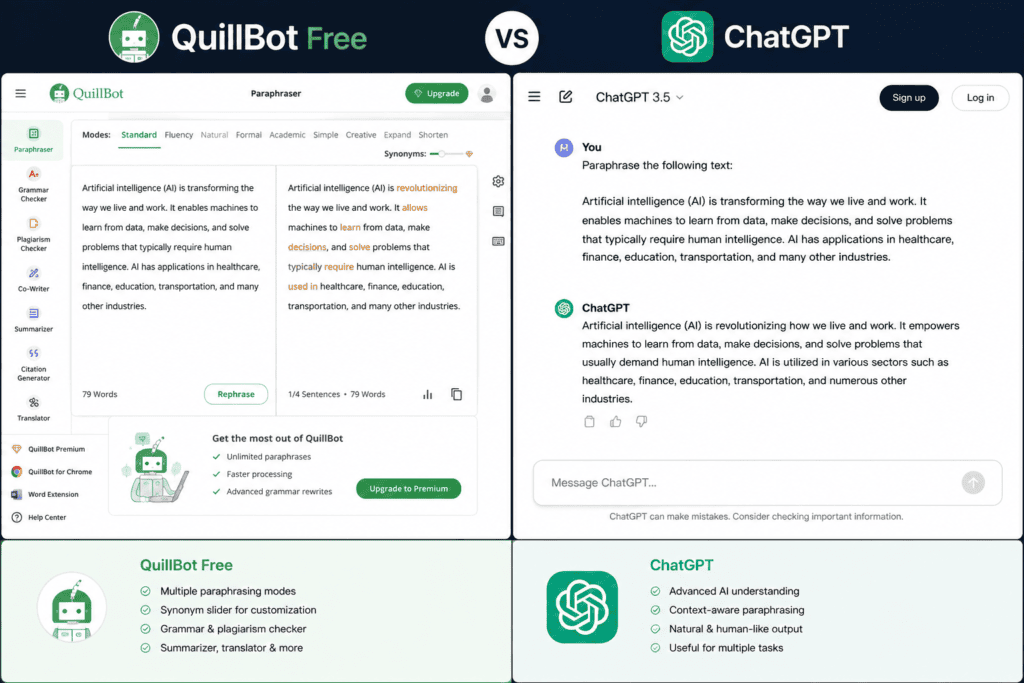
QuillBot Free vs ChatGPT: Paraphrasing sounds easy until you actually have to do it.
You have a sentence that feels awkward, a paragraph that is too repetitive, or an article that needs to be rewritten without changing its original meaning. You paste it into an AI tool, press a button, and expect a perfect version.
Sometimes you get exactly what you wanted.
Other times, the wording changes so much that the original meaning disappears.
That is why choosing the right paraphrasing tool matters.
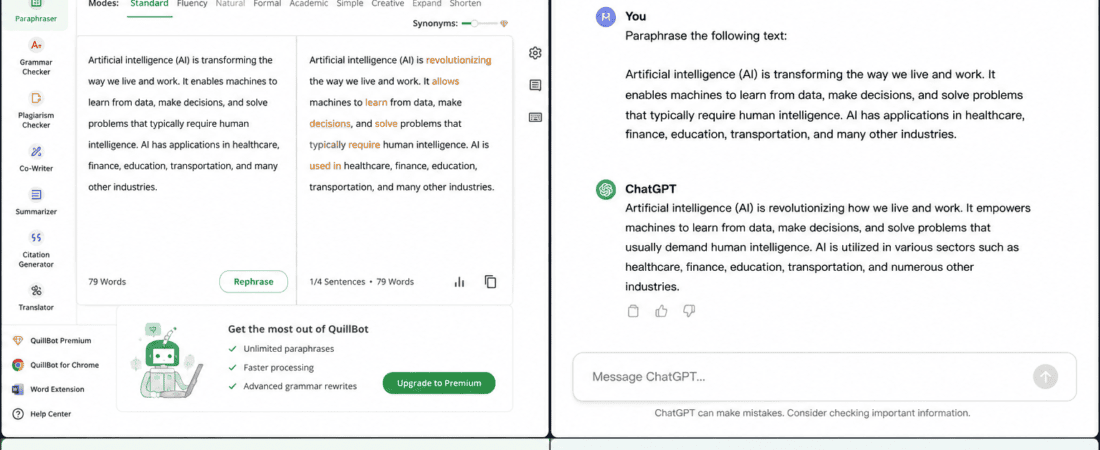
Two popular options are QuillBot and ChatGPT. QuillBot was built around writing improvement and paraphrasing, while ChatGPT is a general-purpose AI assistant that can rewrite, explain, summarize, expand, shorten, and transform text in many different ways.
But if your only question is:
QuillBot Free vs ChatGPT: which is better for paraphrasing?
The answer depends on what you are rewriting and how much control you need.
QuillBot can be convenient when you want a quick rewrite with different preset styles. ChatGPT can be more flexible when you want to give detailed instructions about tone, audience, length, vocabulary, structure, or meaning.
There is also an important difference between a dedicated paraphrasing tool and a conversational AI assistant.
In this guide, we’ll compare QuillBot Free and ChatGPT for paraphrasing, rewriting sentences, improving paragraphs, preserving meaning, changing tone, academic writing, blog content, SEO writing, grammar improvement, readability, bulk content workflows, and everyday writing.
We’ll also look at their limitations and explain which one makes more sense for different users.
QuillBot Free vs ChatGPT: Quick Comparison
| Feature | QuillBot Free | ChatGPT |
|---|---|---|
| Main purpose | Writing and paraphrasing | General-purpose AI assistant |
| Dedicated paraphrasing | Yes | Yes, through prompts |
| Beginner friendly | Excellent | Excellent |
| Preset paraphrasing modes | Yes, with free-plan limitations | No fixed paraphrasing modes in the same way |
| Custom instructions | Limited compared with ChatGPT | Excellent |
| Sentence rewriting | Excellent | Excellent |
| Paragraph rewriting | Excellent | Excellent |
| Tone control | Good | Excellent |
| Context understanding | Good | Excellent |
| Grammar improvement | Strong | Strong |
| SEO rewriting | Good | Excellent with instructions |
| Academic rewriting | Useful | Useful |
| Bulk rewriting | Limited by plan/usage | Depends on current limits |
| Creativity | Moderate to high | High |
| Best for quick paraphrasing | QuillBot | — |
| Best for customized rewriting | — | ChatGPT |
| Best overall flexibility | — | ChatGPT |
The table gives us the basic answer.
But the real difference becomes clearer when we look at actual workflows.
What Is QuillBot?
QuillBot is an AI-powered writing tool designed specifically around rewriting and improving text.
It offers features for:
- Paraphrasing
- Grammar checking
- Summarization
- Citation assistance
- Translation
- Writing improvement
Its paraphraser is one of its best-known features.
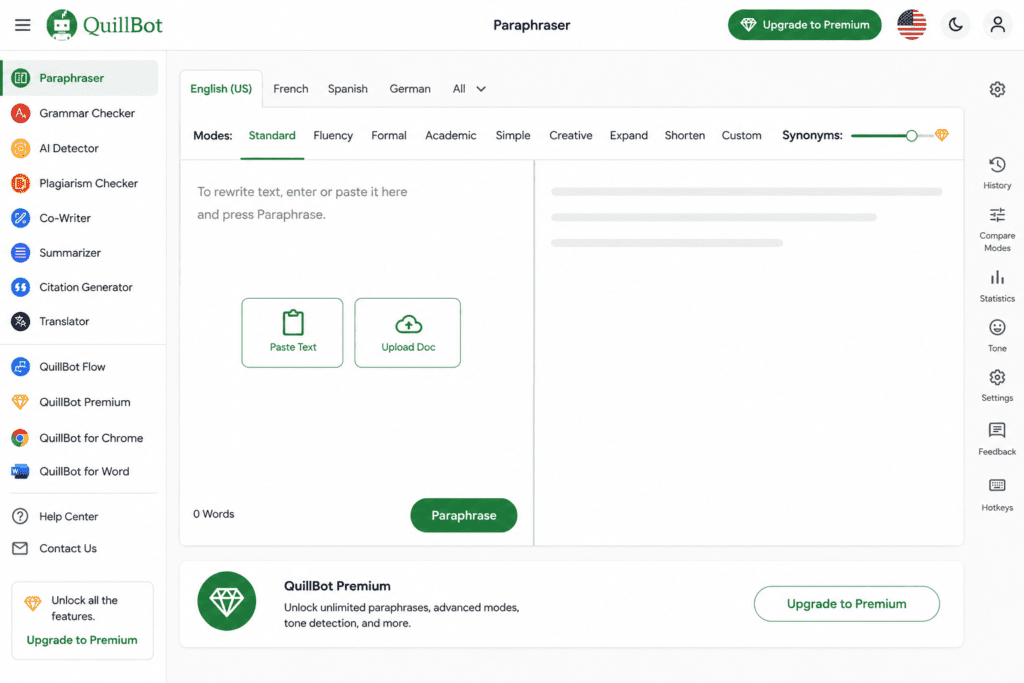
Instead of asking an AI assistant to rewrite something through a prompt, you can paste your text into QuillBot’s paraphrasing interface and select an available mode.
This makes the workflow extremely straightforward.
The basic process is:
Paste → Choose mode → Paraphrase → Review
That simplicity is one of QuillBot’s biggest strengths.
If I have a paragraph that needs a quick rewrite and I don’t want to spend time writing instructions, a dedicated paraphrasing interface can be convenient.
What Is ChatGPT?
ChatGPT is a general-purpose AI assistant.
Unlike a dedicated paraphrasing application, it isn’t limited to rewriting.
You can ask it to:
- Rewrite
- Paraphrase
- Summarize
- Explain
- Expand
- Shorten
- Translate
- Change tone
- Improve grammar
- Simplify language
- Rewrite for a specific audience
- Turn notes into an article
That flexibility changes the paraphrasing experience.
Instead of simply saying:
Paraphrase this.
You can give much more detailed instructions.
For example:
Rewrite this paragraph in natural, conversational English. Preserve the original meaning and factual claims. Use simpler vocabulary, avoid unnecessary adjectives, and keep approximately the same length.
That level of instruction is one of ChatGPT’s biggest advantages.
QuillBot Free vs ChatGPT: Which Is Better for Quick Paraphrasing?
Let’s say I have a paragraph and simply want different wording.
I don’t want to analyze the paragraph.
I don’t want to explain my desired tone.
I just want another version.
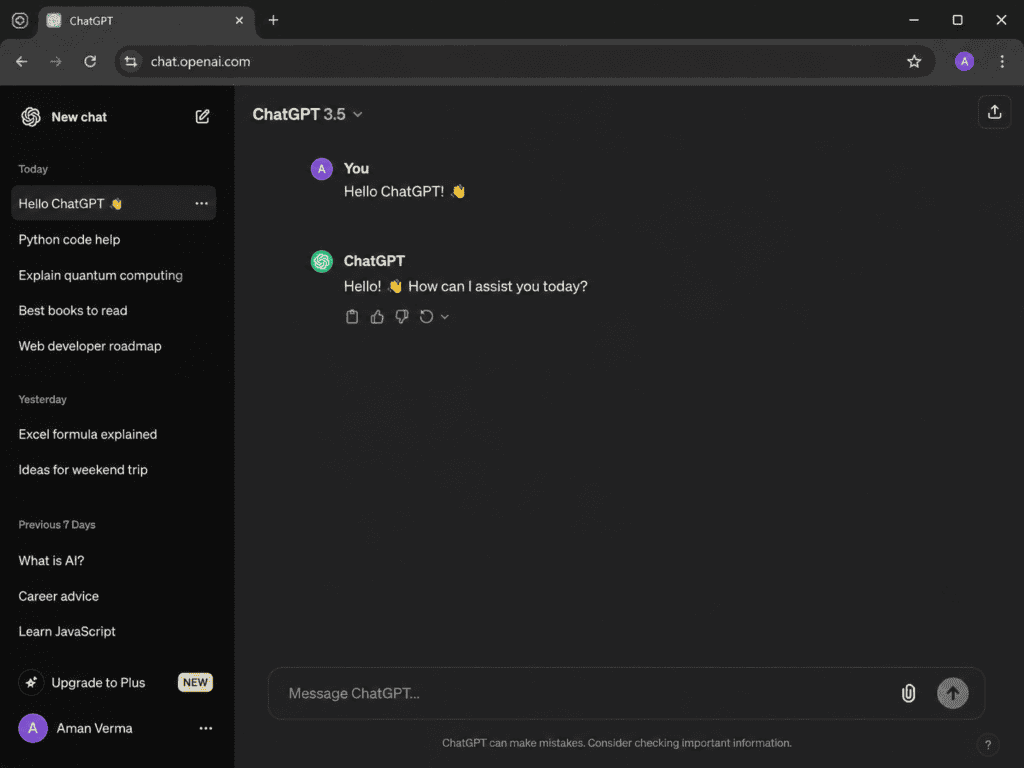
This is where QuillBot feels particularly convenient.
I can paste the content into its paraphrasing tool, select the appropriate available mode, and generate a rewritten version.
There are fewer decisions to make.
ChatGPT can do exactly the same thing, but I need to communicate what I want through a prompt.
For experienced AI users, that’s not really difficult.
For someone who wants a dedicated button specifically for paraphrasing, QuillBot can feel more direct.
Winner: QuillBot Free
QuillBot Free vs ChatGPT for Customized Rewriting
Now imagine a different requirement.
I don’t simply want the text rewritten.
I want it to sound:
- Friendly
- Natural
- Professional
- Concise
- Less repetitive
- Suitable for beginners
I might give ChatGPT a detailed instruction like:
Rewrite this paragraph for beginner readers. Keep the meaning exactly the same, remove repetition, use natural sentence structures, and make the tone friendly but professional.
ChatGPT can respond to these instructions directly.
This makes it much more flexible than a simple paraphrasing workflow.
Winner: ChatGPT
Which Tool Preserves Meaning Better?
This is one of the most important questions.
A paraphrase isn’t successful simply because the words changed.
The original meaning must remain intact.
For example:
Original:
AI tools can help bloggers reduce the time required to create content.
A good paraphrase might be:
Bloggers can use AI tools to spend less time producing content.
The wording changed.
The meaning didn’t.
A poor paraphrase could accidentally imply that AI completely automates blogging.
That’s not the same statement.
Both QuillBot and ChatGPT can preserve meaning, but neither should be trusted blindly.
This is especially important for:
- Legal text
- Academic writing
- Medical information
- Financial information
- Technical content
When accuracy matters, always compare the rewritten version with the original.
Winner: Tie
The quality depends heavily on the source material and instructions.
QuillBot Free vs ChatGPT for Sentence Paraphrasing
Sentence-level paraphrasing is where both tools perform well.
Suppose the original sentence is:
Many businesses use social media platforms to reach potential customers.
A paraphrased version could be:
Social media platforms are used by many businesses to connect with potential customers.
The meaning remains similar.
QuillBot is convenient for this because its interface is specifically designed around rewriting.
ChatGPT becomes more useful when I want something more specific.
For example:
Rewrite this sentence in five different ways. Keep the meaning unchanged. Make one version formal, one conversational, one concise, one suitable for a blog, and one suitable for LinkedIn.
That’s where ChatGPT becomes more powerful.
Winner for simple rewriting: QuillBot
Winner for multiple customized versions: ChatGPT
QuillBot Free vs ChatGPT for Paragraph Paraphrasing
Paragraphs are more complicated than individual sentences because the relationship between sentences matters.
A good paragraph paraphrase should preserve:
- Main idea
- Supporting information
- Logical flow
- Context
- Relationships between statements
ChatGPT can be particularly useful here because you can tell it to preserve the paragraph’s structure.
For example:
Paraphrase this paragraph while keeping the same main argument, sequence of ideas, and approximate length. Do not add new claims.
This is a useful instruction when accuracy matters.
QuillBot can also paraphrase paragraphs quickly, which makes it useful for straightforward rewriting.
Winner: ChatGPT
Which Is Better for Changing Tone?
Tone is one of ChatGPT’s strongest areas.
You can ask for:
- Professional
- Friendly
- Casual
- Persuasive
- Academic
- Conversational
- Confident
- Simple
- Technical
- Customer-friendly
For example:
Rewrite this email so it sounds professional but not cold.
Or:
Rewrite this paragraph so a 10-year-old can understand it.
Or:
Make this product description persuasive without sounding exaggerated.
QuillBot’s modes can influence the style of a paraphrase, but ChatGPT allows much more detailed instructions.
Winner: ChatGPT
QuillBot Free vs ChatGPT for Blog Writing
Bloggers frequently paraphrase information while researching articles.
However, there is an important distinction:
Paraphrasing should not be used to disguise copied content.
If you use another writer’s ideas or research, you should still provide appropriate attribution where necessary.
For your own drafts, ChatGPT can be useful for turning rough notes into smoother paragraphs.
For example:
Rewrite this paragraph in a natural blog-writing style. Keep the information unchanged and make the sentences easier to read.
QuillBot is also useful when you already have a paragraph and simply need alternative wording.
Winner for full blog-writing workflow: ChatGPT
Winner for quick paraphrasing: QuillBot
QuillBot Free vs ChatGPT for SEO Content
SEO writing often requires more than changing words.
You may want to:
- Include a target keyword naturally
- Improve readability
- Remove repetition
- Strengthen headings
- Create variations
- Maintain search intent
- Improve introductions
ChatGPT can handle these instructions together.
For example:
Rewrite this paragraph for an SEO blog targeting the keyword “free AI writing tools.” Keep the keyword natural and avoid keyword stuffing. Preserve the original meaning.
This is more flexible than simply selecting a paraphrasing mode.
However, AI shouldn’t be used to randomly insert keywords into every sentence.
Good SEO writing still needs to be useful to readers.
Winner: ChatGPT
QuillBot Free vs ChatGPT for Academic Writing
Both tools can help students and researchers improve wording.
For example, you can use them to make an awkward sentence clearer.
But paraphrasing academic material requires care.
Changing words isn’t enough.
You need to understand:
- The original argument
- The author’s intended meaning
- The evidence
- The context
And if you’re paraphrasing someone else’s work, proper citation is still necessary.
ChatGPT can be helpful for explaining a difficult passage before you rewrite it.
For example:
Explain this paragraph in simple language first. Then provide a paraphrased version that preserves the original meaning.
That two-step workflow can be useful.
QuillBot is convenient when you already understand the material and simply need wording alternatives.
Winner for guided academic assistance: ChatGPT
Winner for quick academic paraphrasing: QuillBot
Which Is Better for Grammar Improvement?
QuillBot has a dedicated grammar-checking workflow, which makes it convenient for correcting writing.
ChatGPT can also identify grammatical problems and rewrite sentences.
For example:
Correct the grammar but don’t change my writing style.
This distinction matters.
Sometimes you don’t want AI to rewrite everything.
You only want errors corrected.
Winner for dedicated grammar workflow: QuillBot
Winner for contextual editing: ChatGPT
QuillBot Free vs ChatGPT for Making Writing Simpler
This is an area where ChatGPT is particularly useful.
You can provide a specific instruction:
Rewrite this paragraph using simple English suitable for someone who is learning English.
Or:
Reduce the reading difficulty without removing important information.
You can also ask for explanations of difficult words.
QuillBot can simplify text through its paraphrasing options, but ChatGPT gives you more control over the exact reading level and audience.
Winner: ChatGPT
Which Is Better for Professional Emails?
ChatGPT is generally more versatile here.
Instead of simply paraphrasing an email, you can explain the situation.
For example:
Rewrite this email to my client. I need to tell them the deadline has moved by three days. Keep the message professional, take responsibility, and avoid sounding defensive.
That’s more than paraphrasing.
It’s communication assistance.
QuillBot can rewrite the resulting message, but ChatGPT can work from the situation itself.
Winner: ChatGPT
QuillBot Free vs ChatGPT for Social Media Captions
Again, ChatGPT has an advantage because captions require creativity.
You can ask for:
- 10 captions
- Different tones
- Short versions
- Emoji-free versions
- Professional versions
- Funny versions
- CTA-focused versions
For example:
Rewrite this caption into five short Instagram captions. Keep them casual and avoid clichés.
QuillBot is less suited to generating multiple creative directions from scratch.
Winner: ChatGPT
Which Is Better for Rewriting Product Descriptions?
Both can help.
If you already have a product description and want alternative wording, QuillBot is convenient.
But if you want the description rewritten for a particular audience, ChatGPT becomes more useful.
For example:
Rewrite this product description for young professionals. Highlight convenience and quality. Keep it under 80 words and avoid exaggerated claims.
ChatGPT can handle all of those requirements simultaneously.
Winner: ChatGPT
QuillBot Free vs ChatGPT for Bulk Paraphrasing
Bulk work is a common reason people look for AI paraphrasing tools.
Imagine you have:
- 20 product descriptions
- 30 social captions
- 50 short paragraphs
- Multiple blog sections
The temptation is to paste everything into one prompt and say:
Paraphrase all of this.
That’s not always the best approach.
Long batches can produce inconsistent results.
A better workflow is to establish a consistent instruction first.
For example:
Rewrite each paragraph independently. Preserve the original meaning. Keep approximately the same length. Do not combine paragraphs. Do not add facts.
Then process manageable batches and review the output.
QuillBot can be convenient for straightforward repeated paraphrasing, but usage limits depend on the current plan.
ChatGPT’s ability to follow detailed batch instructions can be particularly useful.
Winner: ChatGPT for customized bulk workflows
QuillBot Free vs ChatGPT: Which Sounds More Natural?
This is a difficult category because “natural” is subjective.
A good paraphrase shouldn’t sound like someone replaced every word with a synonym.
For example:
Awkward:
The utilization of AI tools facilitates the enhancement of content creation efficiency.
Natural:
AI tools can make content creation faster and easier.
The second version isn’t simply a synonym swap.
It restructures the sentence.
ChatGPT is particularly useful for this type of natural rewriting because you can explicitly request conversational sentence structures.
QuillBot can also produce natural results, but the output depends on the selected mode and source text.
Winner: ChatGPT
Which Tool Is Better at Avoiding Repetition?
ChatGPT can be useful when a paragraph repeatedly uses the same words or sentence structures.
You can tell it:
Remove repetitive wording while preserving all important information.
It can then restructure the paragraph.
QuillBot’s paraphrasing can also reduce repeated words, but ChatGPT gives you more control over what should remain unchanged.
Winner: ChatGPT
QuillBot Free vs ChatGPT for Human-Sounding Writing
If the goal is simply to make writing sound less robotic, don’t rely on replacing words.
Natural writing usually comes from:
- Clear ideas
- Varied sentence lengths
- Specific examples
- Appropriate vocabulary
- Logical transitions
- A consistent voice
A useful prompt is:
Rewrite this paragraph in natural, conversational English. Avoid unnecessary formal language, repetitive sentence structures, and generic filler. Keep the original meaning.
This gives ChatGPT clear constraints.
QuillBot can also improve readability, but it is primarily focused on paraphrasing rather than developing a broader writing voice.
Winner: ChatGPT
Can QuillBot and ChatGPT Bypass AI Detectors?
This is a common question, but it is also the wrong way to think about paraphrasing.
AI detectors are not reliable proof of authorship, and deliberately rewriting content to evade detection isn’t a sound content strategy.
The better goal is to create genuinely useful writing.
Use AI to:
- Improve clarity
- Fix grammar
- Organize ideas
- Reduce repetition
- Explore alternative wording
Then add your own:
- Knowledge
- Examples
- Experience
- Opinions
- Research
- Editing
That produces better content regardless of whether a detector flags it.
QuillBot Free vs ChatGPT: Which Is Better for Rewriting Without Changing Meaning?
This is probably the most important category for a paraphrasing comparison.
When you want strict meaning preservation, your prompt should explicitly say so.
For ChatGPT, I would use:
Paraphrase the following text without changing its meaning. Do not add new information, remove important details, change numbers, or alter the original claims. Keep the length similar.
Then compare the output with the original.
With QuillBot, select a mode that prioritizes clarity while checking the resulting paragraph carefully.
Neither tool should be treated as a guaranteed meaning-preservation machine.
Winner: Tie
The user’s review is still essential.
Practical Prompt Templates for ChatGPT Paraphrasing
Here are some useful prompts.
Simple paraphrasing
Paraphrase this text while keeping the original meaning unchanged.
Natural rewriting
Rewrite this paragraph in natural, conversational English while preserving the original meaning.
Professional rewriting
Rewrite this message in professional English. Keep the meaning unchanged and avoid unnecessarily formal language.
Simple English
Rewrite this paragraph using simple English that is easy for beginners to understand.
SEO rewriting
Rewrite this paragraph for an SEO blog. Keep the target keyword natural, preserve the original meaning, and avoid keyword stuffing.
Concise rewriting
Rewrite this paragraph in fewer words while preserving every important point.
Multiple variations
Give me five different paraphrases of this sentence. Keep the meaning identical but vary the sentence structure.
Grammar-only editing
Correct grammar and punctuation only. Do not rewrite the sentence unnecessarily.
How to Get Better Results From QuillBot
A paraphrasing tool works best when you give it clean source material.
Before paraphrasing:
- Remove unnecessary repetition.
- Fix obvious factual errors.
- Break very long paragraphs into logical sections.
- Make sure the original meaning is clear.
- Decide whether you want simple or sophisticated wording.
Then paraphrase.
Afterward:
- Compare the output with the original.
- Check factual statements.
- Look for awkward wording.
- Check terminology.
- Make sure the meaning hasn’t changed.
This final editing step is extremely important.
How to Get Better Results From ChatGPT
The quality of ChatGPT’s paraphrasing depends heavily on the instructions you provide.
Instead of:
Paraphrase this.
Try:
Rewrite this paragraph in natural English. Preserve every factual claim and the original meaning. Keep approximately the same length. Don’t add examples or information that isn’t already present.
This gives the model a much clearer target.
You can also specify:
- Audience
- Tone
- Length
- Reading level
- Industry
- Formatting
- Vocabulary
The more specific the actual requirement, the more useful the result tends to be.
QuillBot Free vs ChatGPT: Main Advantages
QuillBot Free advantages
- Dedicated paraphrasing interface
- Easy workflow
- Quick rewriting
- Writing-focused tools
- Multiple paraphrasing modes
- Useful for sentence and paragraph alternatives
- Convenient for users who don’t want to write prompts
ChatGPT advantages
- Extremely flexible instructions
- Strong contextual understanding
- Multiple rewriting styles
- Tone control
- Audience-specific rewriting
- Can explain the original text
- Can summarize before rewriting
- Can generate multiple versions
- Can combine paraphrasing with other writing tasks
QuillBot Free vs ChatGPT: Main Disadvantages
QuillBot Free limitations
The free version has usage and feature restrictions compared with paid plans.
Its dedicated nature is also a limitation when your task goes beyond paraphrasing.
For example, if you need to research an idea, create an outline, rewrite an email based on a situation, and then generate multiple versions, you’ll probably want a more general AI assistant.
ChatGPT limitations
ChatGPT is not specifically a paraphrasing application.
That means you need to give it clear instructions.
It can also sometimes make unwanted changes to:
- Facts
- Numbers
- Terminology
- Context
- Tone
This is why proofreading remains important.
Which One Should Students Use?
For quick paraphrasing, QuillBot is convenient.
For understanding a difficult paragraph and then rewriting it in your own words, ChatGPT can be more useful.
However, students should not use either tool to disguise copied material.
A better academic workflow is:
Read → Understand → Take notes → Write → Use AI for editing → Cite sources
AI should support learning rather than replace it.
Which One Should Bloggers Use?
For bloggers, I’d choose ChatGPT as the more versatile tool.
A blog writer might need to:
- Generate ideas
- Create outlines
- Rewrite paragraphs
- Improve introductions
- Simplify explanations
- Generate FAQs
- Create meta descriptions
- Draft social posts
ChatGPT can assist with all of these tasks.
QuillBot remains useful as a dedicated rewriting tool, especially when you already have a finished paragraph and want quick alternative wording.
Which One Should Freelancers Use?
Freelancers often switch between different types of writing.
One client may need a website page.
Another may need product descriptions.
Another may need social captions.
Another may need an email.
For this type of mixed workflow, ChatGPT is generally more flexible.
QuillBot can still be useful as a secondary writing tool.
Which One Is Better for Beginners?
This depends on what “beginner” means.
If you’re a beginner who simply wants:
“Rewrite this paragraph.”
QuillBot may feel easier.
If you’re a beginner who wants to learn how to use AI for many writing tasks, ChatGPT offers more possibilities.
Quick paraphrasing beginner: QuillBot
AI writing beginner: ChatGPT
Final Verdict: QuillBot Free vs ChatGPT
So, which is better for paraphrasing?
There isn’t one universal winner.
But if I had to choose based on the type of work, I’d divide it this way.
Choose QuillBot Free if:
- You mainly need paraphrasing.
- You want a dedicated rewriting interface.
- You prefer preset modes.
- You want quick sentence and paragraph alternatives.
- You don’t want to write detailed prompts.
Choose ChatGPT if:
- You need customized paraphrasing.
- You care about tone and audience.
- You want multiple versions.
- You need contextual rewriting.
- You’re working on blog content.
- You want to simplify or expand text.
- You need help beyond paraphrasing.
For pure, quick paraphrasing, QuillBot remains a very convenient choice.
For flexible, instruction-based rewriting, ChatGPT wins.
If you’re a blogger, freelancer, student, marketer, or content creator who needs more than simple word replacement, I’d lean toward ChatGPT.
The biggest lesson, however, is that good paraphrasing isn’t about changing as many words as possible.
It’s about communicating the same idea more clearly and naturally.
Whether you use QuillBot, ChatGPT, or another AI writing tool, always read the result.
Check the facts.
Compare it with the original.
Make sure the meaning hasn’t changed.
And most importantly, add your own thinking where appropriate.
AI can help you rewrite words.
You are still responsible for what those words mean.
Frequently Asked Questions
Is QuillBot better than ChatGPT for paraphrasing?
QuillBot can be better for quick, dedicated paraphrasing because its interface is specifically designed for rewriting. ChatGPT is generally better when you need detailed instructions, tone control, context, or multiple customized versions.
Is QuillBot Free really free?
QuillBot offers a free version with limitations. Some features and higher usage limits require a paid plan, so check its current plan details before relying on a particular feature.
Can ChatGPT paraphrase text?
Yes. ChatGPT can rewrite sentences, paragraphs, articles, emails, captions, and other text according to instructions.
Which is better for preserving meaning?
Both can preserve meaning, but neither should be trusted blindly. Always compare the rewritten text with the original, particularly when dealing with technical, academic, legal, financial, or factual material.
Which is better for academic paraphrasing?
Both can assist with academic writing. QuillBot is convenient for quick paraphrasing, while ChatGPT is useful when you want to understand, simplify, and rewrite a passage. Proper citations are still required when paraphrasing someone else’s work.
Can I use ChatGPT instead of QuillBot?
Yes. ChatGPT can perform many paraphrasing tasks that users traditionally handled with dedicated rewriting tools.
Can QuillBot write complete blog posts?
QuillBot is primarily known for rewriting and writing assistance. For complete blog ideation, outlining, drafting, research assistance, and revisions, a general-purpose AI assistant such as ChatGPT can offer a broader workflow.
Which is better for SEO rewriting?
ChatGPT is usually more flexible because you can specify the target keyword, search intent, audience, tone, length, and formatting requirements. QuillBot can still be useful for quick wording changes.
Which is better for making AI writing sound natural?
Neither tool should be treated as a magic “humanizer.” Good writing comes from clear ideas, useful information, appropriate examples, and thoughtful editing. ChatGPT gives more control over voice and tone, while QuillBot is convenient for rewriting.
Can paraphrasing tools replace human editors?
No. AI can identify and improve many writing problems, but human review remains important for meaning, accuracy, context, tone, and originality.
Should I use both QuillBot and ChatGPT?
You can. For example, you might use ChatGPT to create a customized rewrite and QuillBot to explore alternative sentence structures. However, using two tools doesn’t automatically produce better writing. Your final review matters more than the number of AI tools involved.
Check out here if you want to know about Notion AI vs Google Docs: Best Free Workspace for Content Creators